Southwick-Daniels Farm

Why it's listed
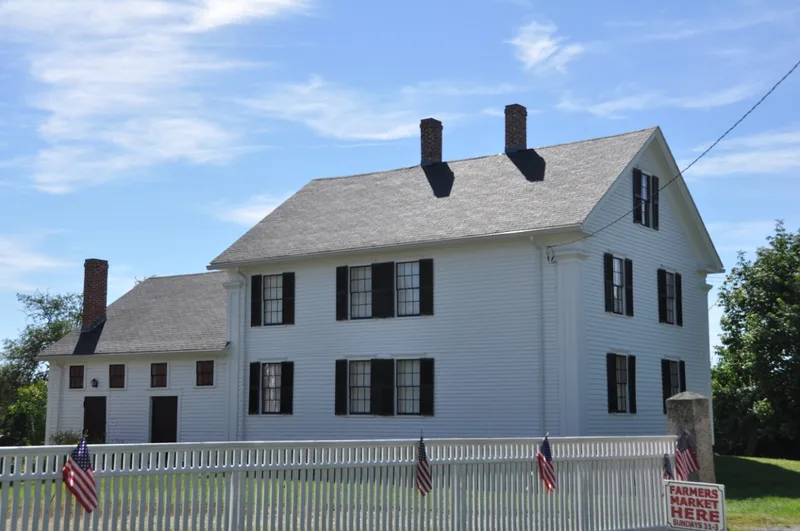
Set on high ground beside Mendon Street in upland Blackstone, this 112-acre farm has stayed in one family since Seth Southwick bought the property in 1793. The house combines a small ca. 1750 dwelling, now a side ell, with a five-bay, two-and-one-half-story Greek Revival main block from about 1830. Around it are a ca. 1850 barn, a ca. 1870 cider mill, a henhouse, corncrib, wellhouses, a cistern, granite gate posts, and a stone drinking trough carved in the 1860s by local mason Daniel Simmons. Stone walls divide fields that still produce hay, and remnants of apple and peach orchards survive. The farm was listed because it is the best preserved working farm complex in Blackstone, illustrating agricultural development from about 1750 to 1945, and because the house and outbuildings retain their original character. The nomination also notes strong potential for archaeological remains from early settlement.
Significance in brief: The nomination calls it the best surviving intact farm complex in Blackstone and one of the best in the Blackstone Valley. It shows two centuries of continuous farming under related Southwick and Daniels families since 1793. It is recognized for agriculture, architecture and social history under Criteria A and C at the local level.
Machine-generated summary. This summary was generated by a language model from the official nomination document and has not been reviewed line by line by an editor. It may contain errors. Check the source document before relying on any detail. Source: nomination document (PDF) · National Archives catalog entry. NRHP reference 95001030, listed August 22, 1995. Summary generated October 2026 (model claude-sonnet-5-5, prompt v1.0-2026-10-29, confidence medium).
Key facts
| Address | 286 Mendon St., Blackstone |
|---|---|
| County | Worcester County |
| Listed | August 22, 1995 |
| Reference number | 95001030 |
| Resource type | District |
| Period of significance | ca. 1750-1945 |
| Architectural style | Mid 19th Century: Greek Revival |
| Criteria |
|
| Areas of significance | Agriculture, Architecture, Social History |
| Level of significance | Local |
| Status (as stated in the nomination) | Described as in excellent condition; the farmhouse remains a dwelling and the fields are still used for agriculture, yielding over 4000 bales of hay per year. |
| Acreage | 112 |
| Coordinates | 42.05857, -71.54958 (NPS GIS) |
What listing means for this property
This is a historic district. Buildings within its boundary are either contributing (they add to the district's significance) or non-contributing. Owners of contributing income-producing buildings can claim the 20% federal rehabilitation tax credit; homeowners should look at state credits. National Register districts impose no design review by themselves; a local historic district ordinance, if one exists, does (the difference explained).
General information, not legal or tax advice. Rules change; confirm with your State Historic Preservation Office or a qualified adviser.
Sources and further reading
- National Park Service, National Register of Historic Places database (snapshot May 2026), reference 95001030.
- Nomination form (PDF, National Archives) — catalog entry
- Wikipedia article (used for cross-checking only; text not reproduced here)
- Wikidata Q7571460
- This listing as JSON
Last updated October 2026. Found an error? See the editorial policy for how to report it.