Fruitlands

Why it's listed
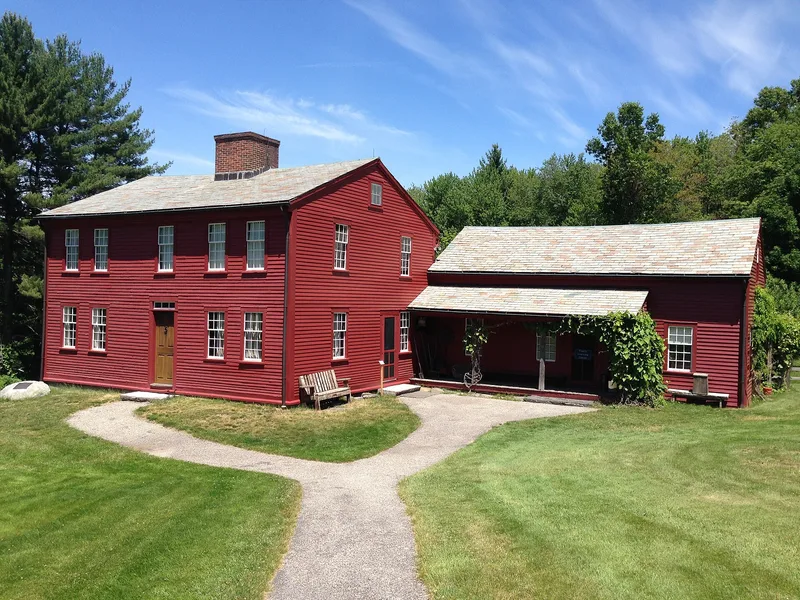
Fruitlands is a simple two-story farmhouse of the late 18th century on Prospect Hill in Harvard, Massachusetts, overlooking the Nashua Valley. It has a five-bay facade, red weatherboard siding, a low stone foundation, a central chimney and a slate gable roof. In 1843 it became the home of a short-lived utopian community led by Bronson Alcott, with Charles Lane, an Englishman who bought the house and about 90 acres. Residents included the Alcott family, among them Louisa May, and never numbered more than sixteen. They followed a strict regimen of vegetarian eating, linen clothing and no private property, and tilled the land by spade. Visitors included Emerson, Hawthorne and Thoreau. Disagreements over the role of the family, a hard first winter and crop failure ended the experiment, and the Alcotts left in January 1844. The house remains on its original site, appears much as it did then, and now serves as a museum with displays on the Transcendentalist movement.
Significance in brief: The farmhouse was the home of Bronson Alcott's "new Eden," a Transcendentalist utopian community founded with Charles Lane. The nomination calls it one of the more characteristic chapters in the history of American utopianism. The house survives on its original site and looks much as it did during the experiment.
Machine-generated summary. This summary was generated by a language model from the official nomination document and has not been reviewed line by line by an editor. It may contain errors. Check the source document before relying on any detail. Source: nomination document (PDF) · National Archives catalog entry. NRHP reference 74001761, listed March 19, 1974. Summary generated October 2026 (model claude-sonnet-5-5, prompt v1.0-2026-10-29, confidence medium).
Key facts
| Address | Prospect Hill, Harvard |
|---|---|
| County | Worcester County |
| Listed | March 19, 1974 |
| Reference number | 74001761 |
| Resource type | District |
| Period of significance | 1843-1844 |
| Architectural style | Late 18th-century New England farmhouse |
| Areas of significance | Social History |
| Level of significance | National |
| National Historic Landmark | Yes, designated May 30, 1974 |
| Status (as stated in the nomination) | Described as in excellent condition, in museum use, on its original site, with rear additions (granary, kitchen, storage sheds) not original to the house. |
| Acreage | 5 |
| Within district | Fruitlands Museums Historic District |
| Coordinates | 42.50980, -71.61155 (NPS GIS) |
What listing means for this property
This is a historic district. Buildings within its boundary are either contributing (they add to the district's significance) or non-contributing. Owners of contributing income-producing buildings can claim the 20% federal rehabilitation tax credit; homeowners should look at state credits. National Register districts impose no design review by themselves; a local historic district ordinance, if one exists, does (the difference explained).
General information, not legal or tax advice. Rules change; confirm with your State Historic Preservation Office or a qualified adviser.
Sources and further reading
- National Park Service, National Register of Historic Places database (snapshot May 2026), reference 74001761.
- Nomination form (PDF, National Archives) — catalog entry
- Wikipedia article (used for cross-checking only; text not reproduced here)
- Wikidata Q5506452
- This listing as JSON
Last updated October 2026. Found an error? See the editorial policy for how to report it.