Fisher, Nathan, House

Why it's listed
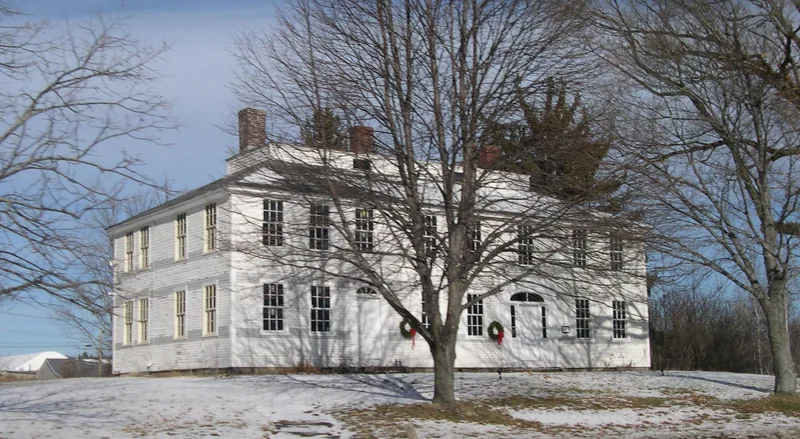
Standing beside Route 9 in Westborough, this two-story Federal style house was built in two stages between 1820 and 1826. Nathan Fisher bought the land in 1820 and is thought to have built the eastern section around 1822. The western third was added, presumably as a shop, and by 1826 Fisher and his brother-in-law Joseph Lothrop had opened the town's first store there. A thread factory on the property later became the first place in Westborough to use steam power. The house has a hip roof with monitor, clapboard siding, granite foundations and two fanlit entries. Its location reflects the prosperity that followed the opening of the Boston-Worcester Turnpike in 1810, a period that faded after the railroad arrived in 1834 and moved the town center southward. In 1884 the Commonwealth bought the house for the Lyman School, which used it as staff housing. It is now only partly occupied and shows signs of deterioration.
Significance in brief: The house is significant for its architecture as a large Federal style building and for commerce, since part of it served as the town's first store. It also shows the brief prosperity (1810-34) that the Boston-Worcester Turnpike brought to the area before the railroad shifted the town center south.
Machine-generated summary. This summary was generated by a language model from the official nomination document and has not been reviewed line by line by an editor. It may contain errors. Check the source document before relying on any detail. Source: nomination document (PDF) · National Archives catalog entry. NRHP reference 80001679, listed March 25, 1980. Summary generated October 2026 (model claude-sonnet-5-5, prompt v1.0-2026-10-29, confidence high).
Key facts
| Address | 34 West Main St., Westborough |
|---|---|
| County | Worcester County |
| Listed | March 25, 1980 |
| Reference number | 80001679 |
| Resource type | Building |
| Period of significance | 1820-1826 |
| Architect / builder | Builder unknown |
| Architectural style | Federal |
| Areas of significance | Industry, Commerce, Transportation, Architecture |
| Level of significance | State, Local |
| Status (as stated in the nomination) | Only a portion of the house is occupied; the form describes the building as deteriorated, with some shutters deteriorated beyond repair. |
| Acreage | 0.9 |
| Coordinates | 42.28425, -71.62464 (NPS GIS) |
What listing means for this property
National Register listing is honorary for a privately owned home: it does not by itself restrict what an owner may do with their own money, and it does not require public access. Restrictions come from local landmark or historic-district ordinances, which are separate (how they differ).
Owner-occupied houses are not eligible for the 20% federal rehabilitation tax credit, which applies to income-producing buildings, but many states offer credits for homeowners. Listing also opens the door to preservation easements and to buying a plaque. Start with what listing means for homeowners, renovating a listed house and selling one.
General information, not legal or tax advice. Rules change; confirm with your State Historic Preservation Office or a qualified adviser.
Sources and further reading
- National Park Service, National Register of Historic Places database (snapshot May 2026), reference 80001679.
- Nomination form (PDF, National Archives) — catalog entry
- Wikipedia article (used for cross-checking only; text not reproduced here)
- Wikidata Q14715748
- This listing as JSON
Last updated October 2026. Found an error? See the editorial policy for how to report it.