Maples Cottage

Why it's listed
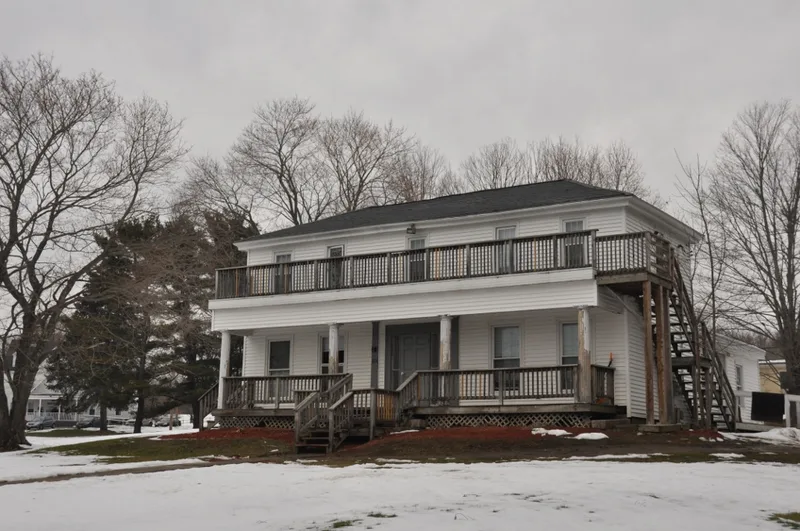
Maples Cottage is a two-story clapboard house on a rise near the junction of Park and Oak Streets in Westborough. Built between 1830 and 1832 by William White, it stands on the foundation of a house erected in 1725 by Ebenezer Parkman, the town's first minister, and reportedly reuses salvaged materials. The rectangular front section has a low hip roof, a Doric entrance, corner pilasters with triglyphs and a one-story columned porch, blending Federal form with early Greek Revival detail. Later changes include oversized first-story windows and double front doors, added around 1860. In 1884 the Commonwealth bought the property for the Lyman School, a reformatory for boys, and the house served as a staff residence until the mid-twentieth century. It is now vacant. The house is valued as a surviving example of the prosperity the Boston-Worcester Turnpike brought to Westborough before the railroad of 1834 moved the town center southward.
Significance in brief: It is an example of transitional Federal/Greek Revival architecture and an important reminder of Westborough's prosperity after the Boston-Worcester Turnpike opened in 1810, before the 1834 railroad shifted the town center. It also shows the turnpike's regional impact on communities along its route. The site dates to 1725, when Ebenezer Parkman, the town's first minister, built a house there.
Machine-generated summary. This summary was generated by a language model from the official nomination document and has not been reviewed line by line by an editor. It may contain errors. Check the source document before relying on any detail. Source: nomination document (PDF) · National Archives catalog entry. NRHP reference 80001681, listed March 25, 1980. Summary generated October 2026 (model claude-sonnet-5-5, prompt v1.0-2026-10-29, confidence high).
Key facts
| Address | 155 Oak St., Westborough |
|---|---|
| County | Worcester County |
| Listed | March 25, 1980 |
| Reference number | 80001681 |
| Resource type | Building |
| Period of significance | 1830-1832 |
| Architect / builder | Builder unknown |
| Architectural style | Transitional Federal/Greek Revival |
| Areas of significance | Transportation, Architecture |
| Level of significance | State, Local |
| Status (as stated in the nomination) | Vacant at the time of nomination; condition rated fair. Formerly a staff residence for the Lyman School, owned by the Commonwealth of Massachusetts. |
| Acreage | 0.9 |
| Within district | Lyman School for Boys |
| Coordinates | 42.28582, -71.62676 (NPS GIS) |
What listing means for this property
National Register listing is honorary for a privately owned home: it does not by itself restrict what an owner may do with their own money, and it does not require public access. Restrictions come from local landmark or historic-district ordinances, which are separate (how they differ).
Owner-occupied houses are not eligible for the 20% federal rehabilitation tax credit, which applies to income-producing buildings, but many states offer credits for homeowners. Listing also opens the door to preservation easements and to buying a plaque. Start with what listing means for homeowners, renovating a listed house and selling one.
Noted as vacant in the nomination. Nomination documents can be decades old; current status may differ. If you are considering buying an empty listed property, read the due-diligence checklist.
General information, not legal or tax advice. Rules change; confirm with your State Historic Preservation Office or a qualified adviser.
Sources and further reading
- National Park Service, National Register of Historic Places database (snapshot May 2026), reference 80001681.
- Nomination form (PDF, National Archives) — catalog entry
- Wikipedia article (used for cross-checking only; text not reproduced here)
- Wikidata Q6754045
- This listing as JSON
Last updated October 2026. Found an error? See the editorial policy for how to report it.