Bigelow Carpet Company Woolen Mills

Why it's listed
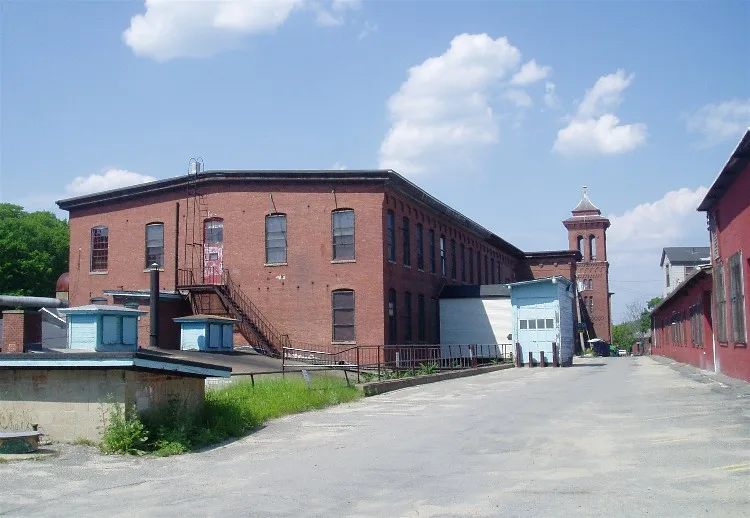
Ten interconnected buildings on about seven acres beside Main Street and Coachlace Pond make up the former Bigelow Carpet Company mills in Clinton, Massachusetts. Most are three-story brick mills built between 1864 and 1898 in an Italianate manner, with low-pitched roofs, narrow segmental-arched windows and decorative brickwork. A five-story tower with a polygonal-roofed belfry rises on Main Street. A small wood-frame building, thought to date from 1810, may be the cotton mill the Bigelow brothers first leased. Erastus Bigelow invented power looms for coachlace and carpet, while his brother Horatio handled the business and civic side of their enterprises. The carpet company bought the site in 1863 and expanded in 1864-66, 1890 and 1898, later merging with other firms before the Clinton plant closed in 1932. The complex is valued for its industrial heritage and its intact ensemble of Victorian mill architecture, and several companies occupy it today.
Significance in brief: The complex is a prominent reminder of Clinton's industrial heritage and is architecturally significant for its elaborate Italianate styling and survival as an ensemble. It retains integrity of design, materials, workmanship, location and setting. It is also tied to Erastus and Horatio Bigelow, whose power loom inventions and business leadership shaped the town's economy.
Machine-generated summary. This summary was generated by a language model from the official nomination document and has not been reviewed line by line by an editor. It may contain errors. Check the source document before relying on any detail. Source: nomination document (PDF) · National Archives catalog entry. NRHP reference 83004107, listed October 6, 1983. Summary generated October 2026 (model claude-sonnet-5-5, prompt v1.0-2026-10-29, confidence high).
Key facts
| Address | Main St., Clinton |
|---|---|
| County | Worcester County |
| Listed | October 6, 1983 |
| Reference number | 83004107 |
| Resource type | Building |
| Period of significance | 1800-1899, 1900- (specific dates 1864, 1876-1898, 1899) |
| Architectural style | Italianate (Victorian industrial) |
| Criteria |
|
| Areas of significance | Industry, Entertainment/Recreation, Architecture |
| Level of significance | Local |
| Status (as stated in the nomination) | Occupied by seven different companies; two of the larger mills recently changed ownership and rehabilitation projects were underway at the time of nomination. |
| Acreage | 7 |
| Coordinates | 42.41704, -71.68993 (NPS GIS) |
What listing means for this property
For an income-producing building, listing (individually or as a contributing building in a district) is the gateway to the 20% federal rehabilitation tax credit on qualified rehabilitation costs, often stackable with state credits. Work claiming the credit must follow the Secretary of the Interior's Standards and be approved in advance.
Listing does not restrict a private owner acting without federal money or permits; where federal funding or licensing is involved, Section 106 review applies.
General information, not legal or tax advice. Rules change; confirm with your State Historic Preservation Office or a qualified adviser.
Sources and further reading
- National Park Service, National Register of Historic Places database (snapshot May 2026), reference 83004107.
- Nomination form (PDF, National Archives) — catalog entry
- Wikipedia article (used for cross-checking only; text not reproduced here)
- Wikidata Q4906805
- This listing as JSON
Last updated October 2026. Found an error? See the editorial policy for how to report it.