East Boston High School, Old
Also known as: Joseph H. Barnes School

Why it's listed
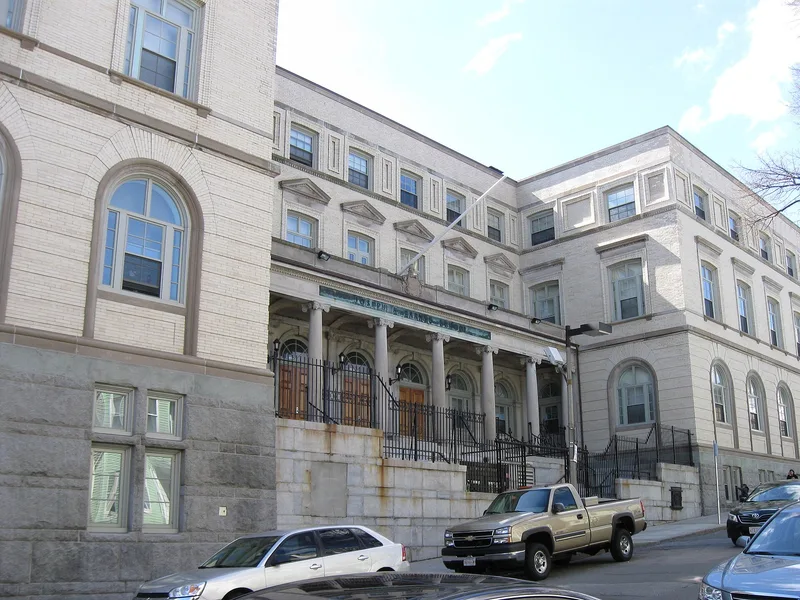
Old East Boston High School, at 127 Marion Street on the south slope of Eagle Hill, is a three-story Renaissance Revival school of buff brick with limestone trim and a granite base. Completed and first occupied in 1901 to designs by John Lyman Faxon, it has a vaulted entrance porch with Ionic columns, carved stone balconies, and an interior of marble wainscoting, terrazzo floors and a domed semicircular auditorium. A 1933 rear addition by Charles Reggio Greco added classrooms and a cafeteria. The school served East Boston's growing population and reflected the new role of high schools as general preparation for college or working life. After a new high school opened on White Street in 1926, the building became the Joseph H. Barnes Intermediate School, named for a Civil War veteran from the neighborhood. Later plans show shops and home economics rooms, indicating a move toward vocational training. The building is now vacant.
Significance in brief: The nomination argues the building is significant for architecture as a Renaissance Revival school designed by John Lyman Faxon, with a 1933 addition by Charles Reggio Greco. It is also significant in education and social history, reflecting the rise of public high school education in East Boston and later shifts toward intermediate and vocational schooling.
Machine-generated summary. This summary was generated by a language model from the official nomination document and has not been reviewed line by line by an editor. It may contain errors. Check the source document before relying on any detail. Source: nomination document (PDF) · National Archives catalog entry. NRHP reference 06000127, listed March 15, 2006. Summary generated October 2026 (model claude-sonnet-5-5, prompt v1.0-2026-10-29, confidence high).
Key facts
| Address | 127 Marion St., Boston |
|---|---|
| County | Suffolk County |
| Listed | March 15, 2006 |
| Reference number | 06000127 |
| Resource type | Building |
| Period of significance | 1901-1955 |
| Architect / builder | John Lyman Faxon; Charles Reggio Greco (1933 addition) |
| Architectural style | Late 19th and 20th Century Revivals: Italian Renaissance (Renaissance Revival) |
| Criteria |
|
| Areas of significance | Architecture, Education, Social History |
| Level of significance | Local |
| Status (as stated in the nomination) | Current function is listed as vacant; the interior has had later alterations, and windows were replaced after 1933. |
| Acreage | 0.9 |
| Within district | Eagle Hill Historic District |
| Coordinates | 42.37806, -71.03740 (NPS GIS) |
What listing means for this property
For a publicly owned building or structure, listing mainly matters when federal funds, permits or licences are involved: projects then go through Section 106 review so effects on the property are considered. Listing also strengthens applications for preservation grants and, for leased income-producing uses, can enable the federal rehabilitation tax credit.
Noted as vacant in the nomination. Nomination documents can be decades old; current status may differ. If you are considering buying an empty listed property, read the due-diligence checklist.
General information, not legal or tax advice. Rules change; confirm with your State Historic Preservation Office or a qualified adviser.
Sources and further reading
- National Park Service, National Register of Historic Places database (snapshot May 2026), reference 06000127.
- Nomination form (PDF, National Archives) — catalog entry
- Wikipedia article (used for cross-checking only; text not reproduced here)
- Wikidata Q7083891
- This listing as JSON
Last updated October 2026. Found an error? See the editorial policy for how to report it.