National Monument to the Forefathers

Why it's listed
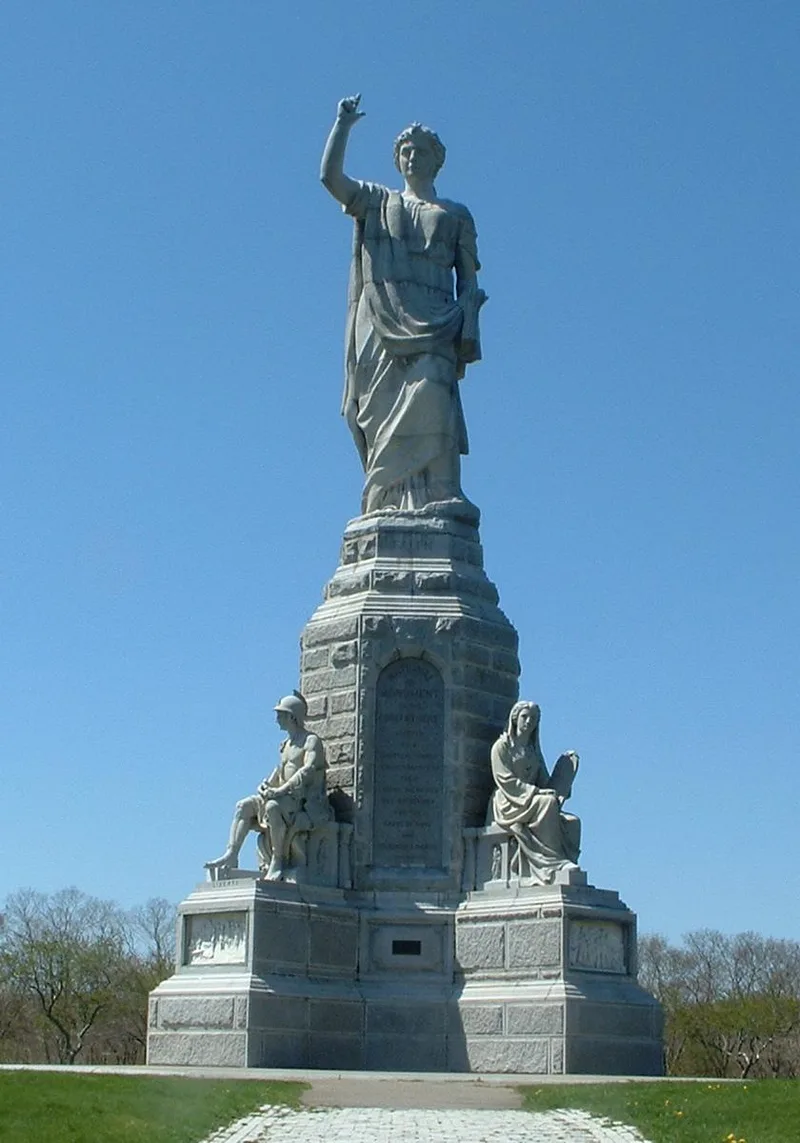
On a hilltop off Allerton Street in Plymouth stands a monument to the Pilgrims, surrounded by lawns and reached by brick paths. Designed by Boston architect Hammatt Billings, it has an octagonal shaft of rusticated granite about 45 feet high. On top is a 36-foot figure of Faith, built from 14 granite blocks weighing 180 tons and shown with a foot on Plymouth Rock and an open Bible in hand. Four seated figures of Morality, Law, Education and Liberty sit on buttress-like plinths at the base, with relief panels depicting the Treaty with Massasoit and the Signing of the Compact. The Pilgrim Society commissioned the work after a competition in 1855. Billings raised funds nationally, but the Civil War and inflation delayed construction, and he died in 1874 before it was finished. His brother Joseph carried on the project. Faith was completed in 1877 and the monument in 1889. It is valued as a major work of Billings and a leading memorial to the Pilgrims.
Significance in brief: The nomination argues it is significant mainly as the work of Hammatt Billings, one of Boston's foremost 19th-century architects and designers. It is typical of Victorian monumental sculpture, which mixed classical and contemporary motifs. It remains one of Billings' major works and one of the major memorials to the Pilgrims.
Machine-generated summary. This summary was generated by a language model from the official nomination document and has not been reviewed line by line by an editor. It may contain errors. Check the source document before relying on any detail. Source: nomination document (PDF) · National Archives catalog entry. NRHP reference 74002033, listed August 30, 1974. Summary generated October 2026 (model claude-sonnet-5-5, prompt v1.0-2026-10-29, confidence high).
Key facts
| Address | Allerton St., Plymouth |
|---|---|
| County | Plymouth County |
| Listed | August 30, 1974 |
| Reference number | 74002033 |
| Resource type | Object |
| Period of significance | 19th Century (specific date 1889) |
| Architect / builder | Hammatt Billings (designer); Joseph Billings continued the work; sculptors included William Rimmer and probably John D. Perry |
| Architectural style | Classical (Roman motifs) in the Victorian monumental sculpture tradition |
| Areas of significance | Art |
| Level of significance | Local |
| Status (as stated in the nomination) | Condition is marked excellent and unaltered, on its original site; the monument is publicly owned by a society and open to the public without restriction. |
| Acreage | 0.9 |
| Coordinates | 41.96018, -70.67602 (NPS GIS) |
What listing means for this property
For a publicly owned building or structure, listing mainly matters when federal funds, permits or licences are involved: projects then go through Section 106 review so effects on the property are considered. Listing also strengthens applications for preservation grants and, for leased income-producing uses, can enable the federal rehabilitation tax credit.
General information, not legal or tax advice. Rules change; confirm with your State Historic Preservation Office or a qualified adviser.
Sources and further reading
- National Park Service, National Register of Historic Places database (snapshot May 2026), reference 74002033.
- Nomination form (PDF, National Archives) — catalog entry
- Wikipedia article (used for cross-checking only; text not reproduced here)
- Wikidata Q4343546
- This listing as JSON
Last updated October 2026. Found an error? See the editorial policy for how to report it.