Bethel African Methodist Episcopal Church and Parsonage

Why it's listed
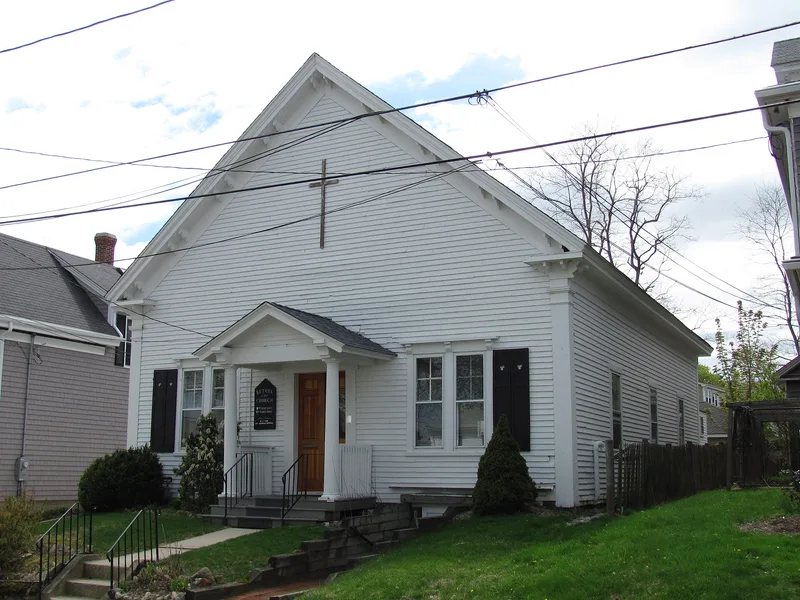
Bethel African Methodist Episcopal Church and its parsonage occupy a small lot at 6 Sever Street in Plymouth, Massachusetts. The church is a 1½-story wood-frame building from about 1840 that mixes Greek Revival and Italianate details, including Doric corner boards, a wide cornice and paired brackets. It was first used for several purposes, then dedicated as an AME church on August 5, 1870, after a group of local trustees acquired it. Behind it stands a plain 1½-story parsonage completed in 1895. Both buildings have been modestly altered over time, including a new foundation after a 1915-16 flood and a fellowship hall excavated in the basement in 1980. The complex is recognized for its long role in the religious and social life of Plymouth's African-American community and for its simple, well-preserved examples of 19th-century vernacular architecture. It remains in use by its congregation.
Significance in brief: The complex is argued to be significant for its long religious, civic and social role and its connection to Plymouth's African-American community, meeting Criteria A and C. The church is a transitional Greek Revival/Italianate building and the parsonage is a vernacular dwelling, together typical of mid- and late-19th-century design in Plymouth. Both retain good integrity and are significant at the local level.
Machine-generated summary. This summary was generated by a language model from the official nomination document and has not been reviewed line by line by an editor. It may contain errors. Check the source document before relying on any detail. Source: nomination document (PDF) · National Archives catalog entry. NRHP reference 07000168, listed March 19, 2007. Summary generated October 2026 (model claude-sonnet-5-5, prompt v1.0-2026-10-29, confidence medium).
Key facts
| Address | 6 Sever St., Plymouth |
|---|---|
| County | Plymouth County |
| Listed | March 19, 2007 |
| Reference number | 07000168 |
| Resource type | Building |
| Period of significance | ca. 1840-1957 |
| Architectural style | Mid-19th Century/Greek Revival/Italianate (church); no style (vernacular parsonage) |
| Criteria |
|
| Areas of significance | Architecture, Religion, Black, Social History |
| Level of significance | Local |
| Status (as stated in the nomination) | Described as in fair to good condition and still in use as a church and parsonage, with about 136 years of continuous religious service. |
| Acreage | 0.9 |
| Coordinates | 41.95714, -70.66846 (NPS GIS) |
What listing means for this property
Religious properties are listed for their architectural or historical significance, not their religious use. Listing is honorary and does not restrict the congregation's use of the building. The federal rehabilitation credit is generally unavailable unless part of the building is income-producing; some state programmes and preservation grants do cover religious buildings. Federal funding or permits trigger Section 106 review.
General information, not legal or tax advice. Rules change; confirm with your State Historic Preservation Office or a qualified adviser.
Sources and further reading
- National Park Service, National Register of Historic Places database (snapshot May 2026), reference 07000168.
- Nomination form (PDF, National Archives) — catalog entry
- Wikipedia article (used for cross-checking only; text not reproduced here)
- Wikidata Q4897857
- This listing as JSON
Last updated October 2026. Found an error? See the editorial policy for how to report it.