Minot's Ledge Light

Why it's listed
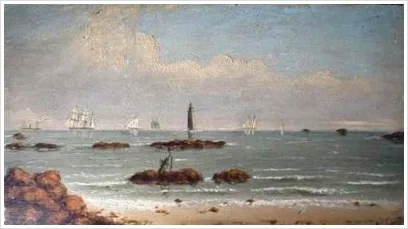
Minot's Ledge Light is a granite lighthouse rising 102 feet from a small rock ledge about a mile off Cohasset and Scituate, Massachusetts. It replaced an iron skeleton tower that a storm toppled in April 1851, killing two keepers. The new tower was designed by General Joseph G. Totten and built under Lt. Barton S. Alexander between 1855 and 1860. Because the ledge is exposed only at extreme low tides, workers needed three seasons just to prepare the foundation. Stones were cut and preassembled on the mainland to ensure a precise fit, with lower courses interlocked and held by iron dowels. The light was first shown on 15 November 1860. Its 1-4-3 signal sequence, adopted in 1894, earned it the nickname Lover's Light. Listed for its engineering importance and its role in coastal navigation, it is among the earliest lighthouses built directly in the open sea and is recognized as an engineering landmark. The Coast Guard automated it in 1947.
Significance in brief: The nomination argues the tower was a major engineering achievement of national importance and is one of only a handful of lighthouses built directly in the sea, the earliest and arguably the most famous. It is a monument to the engineers and stone masons who built it and is recognized as a National Historic Engineering Landmark by the American Society of Civil Engineers. It also has significant ties to the development of aids to navigation in Massachusetts.
Machine-generated summary. This summary was generated by a language model from the official nomination document and has not been reviewed line by line by an editor. It may contain errors. Check the source document before relying on any detail. Source: nomination document (PDF) · National Archives catalog entry. NRHP reference 87001489, listed June 15, 1987. Summary generated October 2026 (model claude-sonnet-5-5, prompt v1.0-2026-10-29, confidence high).
Key facts
| Address | Minot's Ledge, Scituate |
|---|---|
| County | Plymouth County |
| Listed | June 15, 1987 |
| Reference number | 87001489 |
| Resource type | Structure |
| Architect / builder | Designed by General Joseph G. Totten of the Lighthouse Board; construction supervised by Lt. Barton S. Alexander, Army Corps of Engineers |
| Criteria |
|
| Areas of significance | Engineering, Transportation, Architecture, Maritime History |
| Level of significance | National, State, Local |
| Status (as stated in the nomination) | Listed as unmanned and active; automated in 1947 and converted to solar power in 1983. Rehabilitation of masonry cracks at the watchroom level was planned by the Coast Guard for 1987. |
| Acreage | 0.1 |
| Coordinates | 42.26793, -70.76006 (NPS GIS) |
What listing means for this property
National Register listing is honorary: it recognises significance and does not restrict what a private owner may do without federal money or permits. It unlocks the 20% federal rehabilitation tax credit for income-producing buildings, state credits in many states, and Section 106 review when federal agencies are involved. See what listing means in practice.
General information, not legal or tax advice. Rules change; confirm with your State Historic Preservation Office or a qualified adviser.
Sources and further reading
- National Park Service, National Register of Historic Places database (snapshot May 2026), reference 87001489.
- Nomination form (PDF, National Archives) — catalog entry
- Wikipedia article (used for cross-checking only; text not reproduced here)
- Wikidata Q6869325
- This listing as JSON
Last updated October 2026. Found an error? See the editorial policy for how to report it.