Hanover Center Historic District

Why it's listed
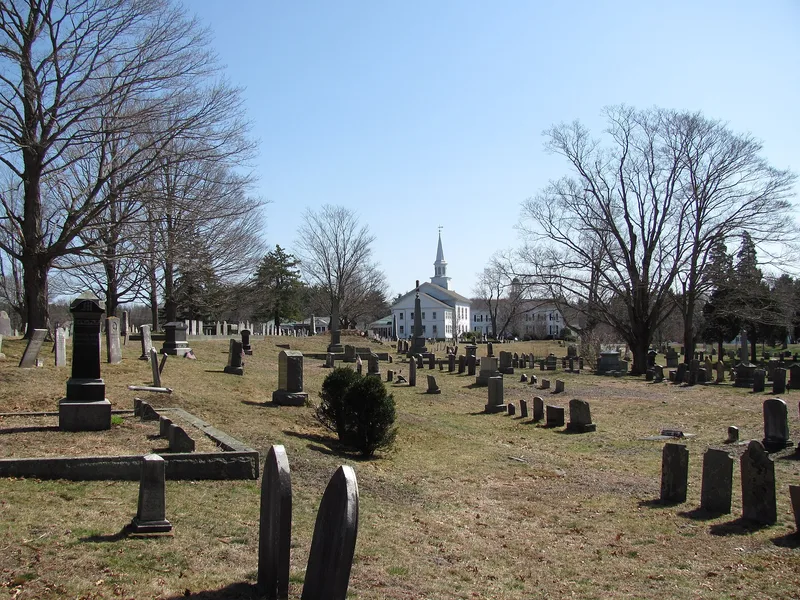
Hanover Center is the historic heart of a Massachusetts town, a 42-acre area where Hanover, Silver, Main and Center Streets meet. Its widely spaced buildings, shade trees and surrounding woods and pastures have kept a rural feel since the town was incorporated in 1727. The oldest resources are the Stetson House and barn, dating to about 1700, and the Hanover Cemetery, whose gravestones span New England carving styles from the early 1700s onward. The Italianate First Congregational Church and Town Hall were both built in 1863 after a fire destroyed their predecessors. A granite Civil War monument followed in 1878, the John Curtis Library in 1907, and the Sylvester School, the town's first high school, in 1927. Together these buildings record the town's religious, civic and educational development. Later additions and a few modern buildings at the edges do not outweigh the district's overall integrity as a well-preserved town center.
Significance in brief: The district holds an unusually complete group of resources tied to the founding and growth of Hanover, which was established in 1727. These include the early Stetson House, the original town cemetery, the 1863 church and Town Hall, the 1907 library and the 1927 high school. It also remains a well-preserved example of a rural civic and institutional town center.
Machine-generated summary. This summary was generated by a language model from the official nomination document and has not been reviewed line by line by an editor. It may contain errors. Check the source document before relying on any detail. Source: nomination document (PDF) · National Archives catalog entry. NRHP reference 96000476, listed May 9, 1996. Summary generated October 2026 (model claude-sonnet-5-5, prompt v1.0-2026-10-29, confidence medium).
Key facts
| Address | Roughly, Silver St. from Lantern Ln. to Hanover St., Hanover |
|---|---|
| County | Plymouth County |
| Listed | May 9, 1996 |
| Reference number | 96000476 |
| Resource type | District |
| Architect / builder | Luther Briggs II (Town Hall, 1863); J. Williams Beal (1893 Town Hall renovations, Soldiers' and Sailors' Monument); Edmund Q. Sylvester (John Curtis Library, 1907); John Woodbridge Beal (Sylvester School, 1927); Donham & Sweeney (1977 Town Hall additions); Kilham, Hopkins & Greeley (1968 library addition) |
| Architectural style | Colonial: Postmedieval English; Colonial: Georgian; Mid-19th Century: Greek Revival; Late Victorian: Italianate; Late 19th and 20th Century Revival: Colonial Revival |
| Areas of significance | Education, Community Planning and Development, Architecture, Politics/Government, Religion |
| Level of significance | Local |
| Status (as stated in the nomination) | Town Hall, library, school, church, parsonage and cemetery continue in their historic functions; the Stetson House is also noted as a museum use. |
| Acreage | 42 |
| Coordinates | 42.11811, -70.84412 (NPS GIS) |
What listing means for this property
This is a historic district. Buildings within its boundary are either contributing (they add to the district's significance) or non-contributing. Owners of contributing income-producing buildings can claim the 20% federal rehabilitation tax credit; homeowners should look at state credits. National Register districts impose no design review by themselves; a local historic district ordinance, if one exists, does (the difference explained).
General information, not legal or tax advice. Rules change; confirm with your State Historic Preservation Office or a qualified adviser.
Sources and further reading
- National Park Service, National Register of Historic Places database (snapshot May 2026), reference 96000476.
- Nomination form (PDF, National Archives) — catalog entry
- Wikipedia article (used for cross-checking only; text not reproduced here)
- Wikidata Q5649371
- This listing as JSON
Last updated October 2026. Found an error? See the editorial policy for how to report it.