Pratt, Capt. Josiah, House

Why it's listed
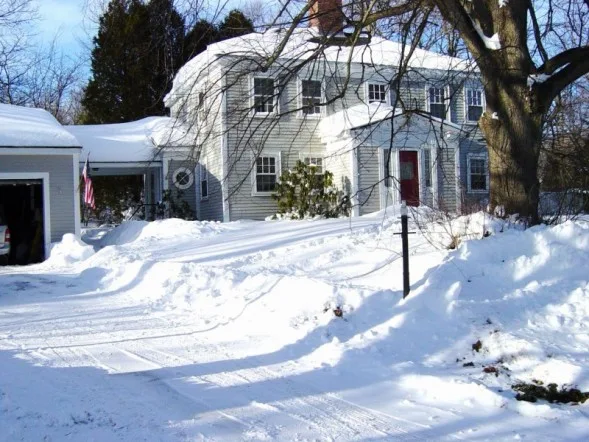
Captain Josiah Pratt's house at 141 East Street in East Foxboro is a two-story wood-frame dwelling on a cut granite foundation, with clapboard siding, a hip roof and a center chimney. Tradition dates it to 1760, though its deep plan, low-pitched roof and Federal interior woodwork suggest it may be as late as 1780. Pratt (1720-1800) was mainly a farmer who also owned a quarry and an iron ore bed. He led a 1753 petition to leave Stoughton, presided over Foxboro's first town meeting, served three terms as selectman, and commanded a company that marched to Lexington on April 19, 1775. The house stayed in the Pratt family until 1927. Later additions, including a Greek Revival doorway, one-story rear rooms and a 1970 garage, reflect changing tastes without harming the original design. Among local houses of its period it is the largest and best preserved, and it reflects the family's standing in a small, struggling town.
Significance in brief: The house is tied to Captain Josiah Pratt, an active 18th-century town leader who was Foxboro's first town meeting moderator, a selectman and a Revolutionary War company commander. It is also an important example of 18th-century architecture in Foxboro. It remains the largest and best preserved house of its period in the town, and it retains integrity of design, location, setting, materials and workmanship.
Machine-generated summary. This summary was generated by a language model from the official nomination document and has not been reviewed line by line by an editor. It may contain errors. Check the source document before relying on any detail. Source: nomination document (PDF) · National Archives catalog entry. NRHP reference 83000598, listed April 21, 1983. Summary generated October 2026 (model claude-sonnet-5-5, prompt v1.0-2026-10-29, confidence high).
Key facts
| Address | 141 East St., Foxboro |
|---|---|
| County | Norfolk County |
| Listed | April 21, 1983 |
| Reference number | 83000598 |
| Resource type | Building |
| Period of significance | 1700-1799 |
| Architectural style | Georgian/Federal period 18th-century house with Federal interior detail and a Greek Revival facade doorway |
| Criteria |
|
| Areas of significance | Military, Politics/Government, Architecture |
| Level of significance | Local |
| Status (as stated in the nomination) | Occupied as a private residence; condition marked excellent, with exterior alterations described as minimal. The original barn across the street was altered into a commercial pool store under separate ownership. |
| Acreage | 0.4 |
| Coordinates | 42.06354, -71.20037 (NPS GIS) |
What listing means for this property
National Register listing is honorary for a privately owned home: it does not by itself restrict what an owner may do with their own money, and it does not require public access. Restrictions come from local landmark or historic-district ordinances, which are separate (how they differ).
Owner-occupied houses are not eligible for the 20% federal rehabilitation tax credit, which applies to income-producing buildings, but many states offer credits for homeowners. Listing also opens the door to preservation easements and to buying a plaque. Start with what listing means for homeowners, renovating a listed house and selling one.
General information, not legal or tax advice. Rules change; confirm with your State Historic Preservation Office or a qualified adviser.
Sources and further reading
- National Park Service, National Register of Historic Places database (snapshot May 2026), reference 83000598.
- Nomination form (PDF, National Archives) — catalog entry
- Wikipedia article (used for cross-checking only; text not reproduced here)
- Wikidata Q5036453
- This listing as JSON
Last updated October 2026. Found an error? See the editorial policy for how to report it.