Fogg Library

Why it's listed
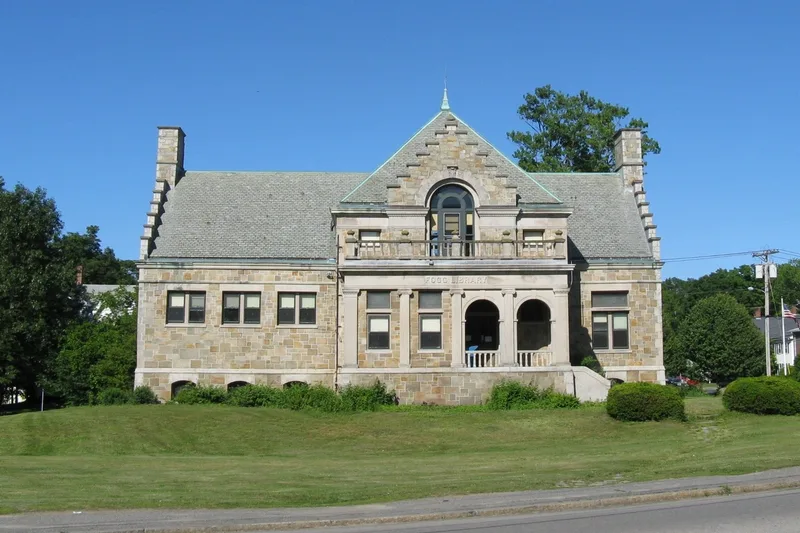
Fogg Library, at 1 Columbian Street in South Weymouth, Massachusetts, is a small stone library built in 1897-1898 to designs by the Worcester firm Cutting, Carlton, and Cutting. It was funded through a bequest from John S. Fogg, a Weymouth banker and shoe manufacturer who died in 1892 and left $50,000 for a free public library in South Weymouth. The building mixes Dutch and classical ideas: step gables on the wings, a Renaissance-style loggia with Doric and Ionic pilasters, limestone trim, a green slate roof and copper details. Inside, quartered oak finishes, Tuscan columns, large fireplaces and stained glass transoms by Redding, Baird, & Co. of Boston survive in an unaltered state. Standing on a generous lot overlooking Columbian Square, it is valued as a civic landmark and as a reminder of nineteenth-century industrial philanthropy. The library later gave up its private charter and became a branch of the town system.
Significance in brief: The nomination presents it as an architectural and visual landmark of South Weymouth and as a monument to the philanthropy of industrialist John S. Fogg. It combines Dutch and classical motifs in an unusual, dignified design. It is argued to meet criteria B and C.
Machine-generated summary. This summary was generated by a language model from the official nomination document and has not been reviewed line by line by an editor. It may contain errors. Check the source document before relying on any detail. Source: nomination document (PDF) · National Archives catalog entry. NRHP reference 81000113, listed June 11, 1981. Summary generated October 2026 (model claude-sonnet-5-5, prompt v1.0-2026-10-29, confidence high).
Key facts
| Address | 1 Columbian St., Weymouth |
|---|---|
| County | Norfolk County |
| Listed | June 11, 1981 |
| Reference number | 81000113 |
| Resource type | Building |
| Period of significance | 1897-98 |
| Architect / builder | Cutting, Carlton, and Cutting (Worcester) |
| Architectural style | Late Victorian eclecticism combining Dutch and classical elements, approaching Italian Renaissance |
| Criteria |
|
| Areas of significance | Architecture |
| Level of significance | Local |
| Status (as stated in the nomination) | Described as in excellent condition, unaltered, on its original site, and occupied. It is publicly owned and now a branch of the town library system. |
| Acreage | 0.5 |
| Coordinates | 42.17451, -70.95058 (NPS GIS) |
What listing means for this property
For a publicly owned building or structure, listing mainly matters when federal funds, permits or licences are involved: projects then go through Section 106 review so effects on the property are considered. Listing also strengthens applications for preservation grants and, for leased income-producing uses, can enable the federal rehabilitation tax credit.
General information, not legal or tax advice. Rules change; confirm with your State Historic Preservation Office or a qualified adviser.
Sources and further reading
- National Park Service, National Register of Historic Places database (snapshot May 2026), reference 81000113.
- Nomination form (PDF, National Archives) — catalog entry
- Wikipedia article (used for cross-checking only; text not reproduced here)
- Wikidata Q5464084
- This listing as JSON
Last updated October 2026. Found an error? See the editorial policy for how to report it.