Emmett Cottage

Why it's listed
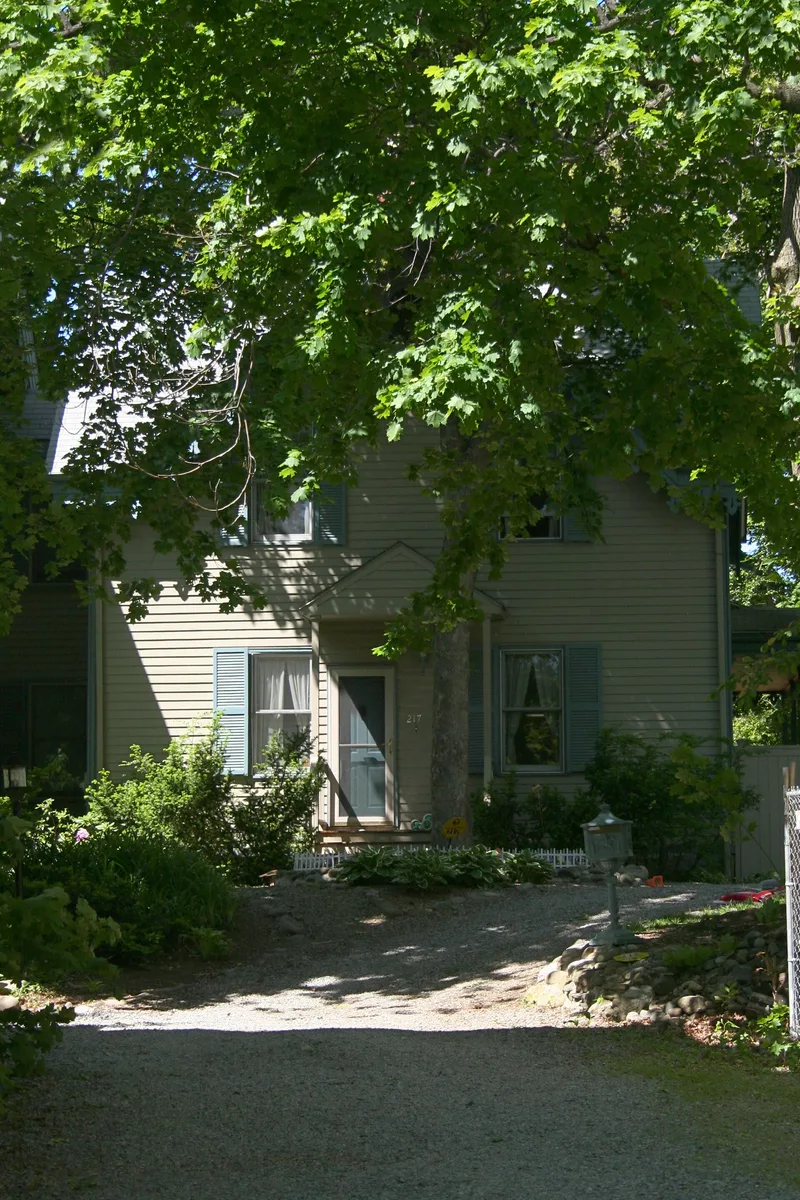
Emmett Cottage is a small Gothic Revival house at 217 Freeman Street in Brookline. It sits well back from the street on a small knoll, in an overgrown lot of about a third of an acre between St. Aidan's Church and the backs of Craig Place houses. Originally square with a cross-gabled roof, it has lively sawn bargeboards, a slate roof and handsome chimney pots, and it recalls designs by A. J. Downing. Its form resembles two altered town gatehouses. Deed and tax research could not fix its date or original owner. Its style points to the 1830s or 1840s, and it may have been a gatehouse moved from a nearby estate. Sign painter John J. Mahoney owned it by 1870, and his heirs held it until the early 1900s, when the Keegan family bought it. Its architectural quality, its largely intact character and its long ownership by members of the local Irish community support its listing.
Significance in brief: The nomination cites Criteria A and C. It is a rare, well-preserved example of Gothic Revival architecture with a simple cross-gabled form, decorative sawn bargeboards, a slate roof and chimney pots. It was also owned for a long period by members of the local Irish community around St. Aidan's Church, and it keeps its mid-19th-century suburban or rural character.
Machine-generated summary. This summary was generated by a language model from the official nomination document and has not been reviewed line by line by an editor. It may contain errors. Check the source document before relying on any detail. Source: nomination document (PDF) · National Archives catalog entry. NRHP reference 85003263, listed October 17, 1985. Summary generated October 2026 (model claude-sonnet-5-5, prompt v1.0-2026-10-29, confidence medium).
Key facts
| Address | 217 Freeman St., Brookline |
|---|---|
| County | Norfolk County |
| Listed | October 17, 1985 |
| Reference number | 85003263 |
| Resource type | Building |
| Architectural style | Gothic Revival |
| Criteria |
|
| Areas of significance | Architecture |
| Level of significance | National, State, Local |
| Status (as stated in the nomination) | Listed on the inventory form as currently unoccupied; the form notes the lot is overgrown. |
| Acreage | 0.9 |
| Coordinates | 42.34784, -71.11983 (NPS GIS) |
What listing means for this property
National Register listing is honorary for a privately owned home: it does not by itself restrict what an owner may do with their own money, and it does not require public access. Restrictions come from local landmark or historic-district ordinances, which are separate (how they differ).
Owner-occupied houses are not eligible for the 20% federal rehabilitation tax credit, which applies to income-producing buildings, but many states offer credits for homeowners. Listing also opens the door to preservation easements and to buying a plaque. Start with what listing means for homeowners, renovating a listed house and selling one.
Noted as vacant in the nomination. Nomination documents can be decades old; current status may differ. If you are considering buying an empty listed property, read the due-diligence checklist.
General information, not legal or tax advice. Rules change; confirm with your State Historic Preservation Office or a qualified adviser.
Sources and further reading
- National Park Service, National Register of Historic Places database (snapshot May 2026), reference 85003263.
- Nomination form (PDF, National Archives) — catalog entry
- Wikipedia article (used for cross-checking only; text not reproduced here)
- Wikidata Q5373514
- This listing as JSON
Last updated October 2026. Found an error? See the editorial policy for how to report it.