Wayside Inn Historic District

Why it's listed
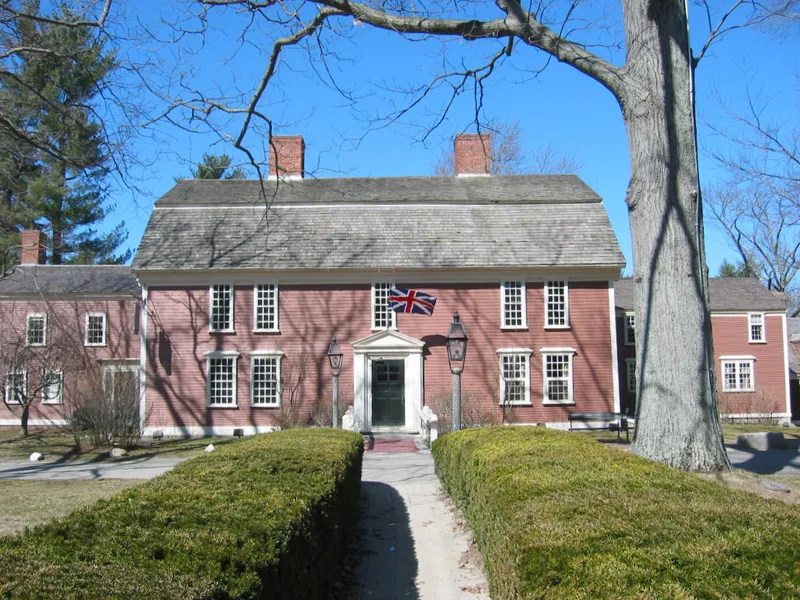
Wayside Inn Historic District occupies about 76 acres in southwest Sudbury, Massachusetts, along the Old Boston Post Road. Its core is the Wayside Inn, a gambrel-roofed building begun around 1700 by the carpenter Samuel Howe and enlarged by later generations of the Howe family. It is believed to be the oldest operating inn in the country and is the setting of Longfellow's Tales of a Wayside Inn, published in 1863. Henry Ford bought the inn in 1923 and surrounded it with related buildings: the Redstone School of 1798, moved from Sterling, a reconstructed 18th century grist mill built in the 1920s, and the Martha-Mary Chapel of 1939. Fire damaged the inn in 1955, and it was restored with a Ford Foundation grant and reopened in 1958. Three architecturally notable houses to the east, including a Greek Revival dwelling known as the Adam Howe House, were added to protect them.
Significance in brief: The Wayside Inn is believed to be the oldest operating inn in the country and is the setting of Longfellow's Tales of a Wayside Inn. The Howe family ran it for generations, and Henry Ford bought it in 1923 and built a complex of related buildings around it. The district also includes three architecturally significant buildings added for protection.
Machine-generated summary. This summary was generated by a language model from the official nomination document and has not been reviewed line by line by an editor. It may contain errors. Check the source document before relying on any detail. Source: nomination document (PDF) · National Archives catalog entry. NRHP reference 73000307, listed April 23, 1973. Summary generated October 2026 (model claude-sonnet-5-5, prompt v1.0-2026-10-29, confidence medium).
Key facts
| Address | Old Boston Post Rd., Sudbury |
|---|---|
| County | Middlesex County |
| Listed | April 23, 1973 |
| Reference number | 73000307 |
| Resource type | District |
| Period of significance | 18th and 19th centuries; specific dates c. 1700; 1863 |
| Architect / builder | Samuel Howe, carpenter (began the inn c. 1700); Henry Ford (chapel, 1939, and refurbishment of the inn) |
| Architectural style | Georgian-era inn with gambrel roof; Greek Revival dwelling; New England meetinghouse style chapel |
| Areas of significance | Literature, Architecture |
| Level of significance | National |
| Status (as stated in the nomination) | Listed in excellent condition and occupied. The inn was damaged by fire in 1955 and restored, reopening in 1958. It is used commercially, as a museum and for private residences. |
| Acreage | 76 |
| Coordinates | 42.35760, -71.46899 (NPS GIS) |
What listing means for this property
This is a historic district. Buildings within its boundary are either contributing (they add to the district's significance) or non-contributing. Owners of contributing income-producing buildings can claim the 20% federal rehabilitation tax credit; homeowners should look at state credits. National Register districts impose no design review by themselves; a local historic district ordinance, if one exists, does (the difference explained).
General information, not legal or tax advice. Rules change; confirm with your State Historic Preservation Office or a qualified adviser.
Sources and further reading
- National Park Service, National Register of Historic Places database (snapshot May 2026), reference 73000307.
- Nomination form (PDF, National Archives) — catalog entry
- Wikipedia article (used for cross-checking only; text not reproduced here)
- Wikidata Q7976878
- This listing as JSON
Last updated October 2026. Found an error? See the editorial policy for how to report it.