Tyler Park Historic District

Why it's listed
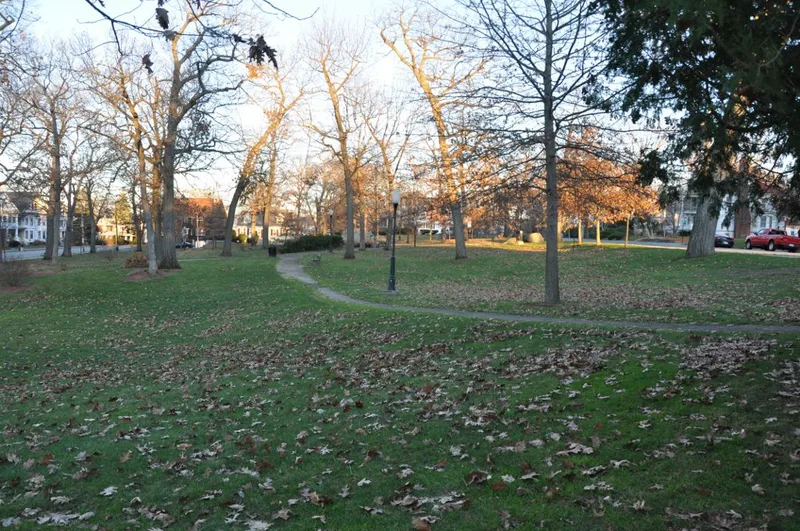
Tyler Park Historic District is a residential neighborhood in the Lowell Highlands, laid out around a small public park designed in 1893 by Charles Eliot of Olmsted, Olmsted and Eliot. The park's 2.74 acres still follow the original plan, which works with a hollow, rocky outcroppings and mature trees. Around it stand mostly wood-frame single- and two-family houses built between about 1890 and 1924, in Queen Anne, Colonial Revival, Craftsman, Bungalow and other styles, along with a few older farmhouse-era dwellings and the 1897 Pine Street School by Harry Prescott Graves. Most houses were built by local builders, and their consistent quality gives the area its cohesion. The district was listed because it shows how Lowell's middle classes moved to streetcar suburbs on higher ground at the turn of the twentieth century. It represents community planning and development, social history and architecture, with a period of significance from 1893 to 1938.
Significance in brief: The district is an excellent, well-preserved example of the suburbanization of industrial Lowell, as the middle classes moved to higher land in commercially developed suburbs. It holds a concentrated group of vernacular houses in many Victorian and revival styles arranged around a planned public park by Charles Eliot. It is significant locally under Criteria A and C.
Machine-generated summary. This summary was generated by a language model from the official nomination document and has not been reviewed line by line by an editor. It may contain errors. Check the source document before relying on any detail. Source: nomination document (PDF) · National Archives catalog entry. NRHP reference 89001056, listed August 17, 1989. Summary generated October 2026 (model claude-sonnet-5-5, prompt v1.0-2026-10-29, confidence high).
Key facts
| Address | Roughly bounded by Princeton, Foster, and Pine Sts., Lowell |
|---|---|
| County | Middlesex County |
| Listed | August 17, 1989 |
| Reference number | 89001056 |
| Resource type | District |
| Period of significance | 1893-1938 |
| Architect / builder | Landscape architect Charles Eliot (Olmsted, Olmsted and Eliot); Harry Prescott Graves (Pine Street School); builders Edmond Douglas and J. Alfred Lequin; many unknown local builders |
| Architectural style | Queen Anne, Colonial Revival, Bungalow/Craftsman |
| Criteria |
|
| Areas of significance | Community Planning and Development, Architecture, Social History |
| Level of significance | Local |
| Status (as stated in the nomination) | Most buildings are in good condition with generally minor alterations. The park remains essentially as constructed, and the Pine Street School is still in use as a school. |
| Acreage | 66.7 |
| Coordinates | 42.63166, -71.34113 (NPS GIS) |
What listing means for this property
This is a historic district. Buildings within its boundary are either contributing (they add to the district's significance) or non-contributing. Owners of contributing income-producing buildings can claim the 20% federal rehabilitation tax credit; homeowners should look at state credits. National Register districts impose no design review by themselves; a local historic district ordinance, if one exists, does (the difference explained).
General information, not legal or tax advice. Rules change; confirm with your State Historic Preservation Office or a qualified adviser.
Sources and further reading
- National Park Service, National Register of Historic Places database (snapshot May 2026), reference 89001056.
- Nomination form (PDF, National Archives) — catalog entry
- Wikipedia article (used for cross-checking only; text not reproduced here)
- Wikidata Q7860111
- This listing as JSON
Last updated October 2026. Found an error? See the editorial policy for how to report it.