Sudbury Center Historic District

Why it's listed
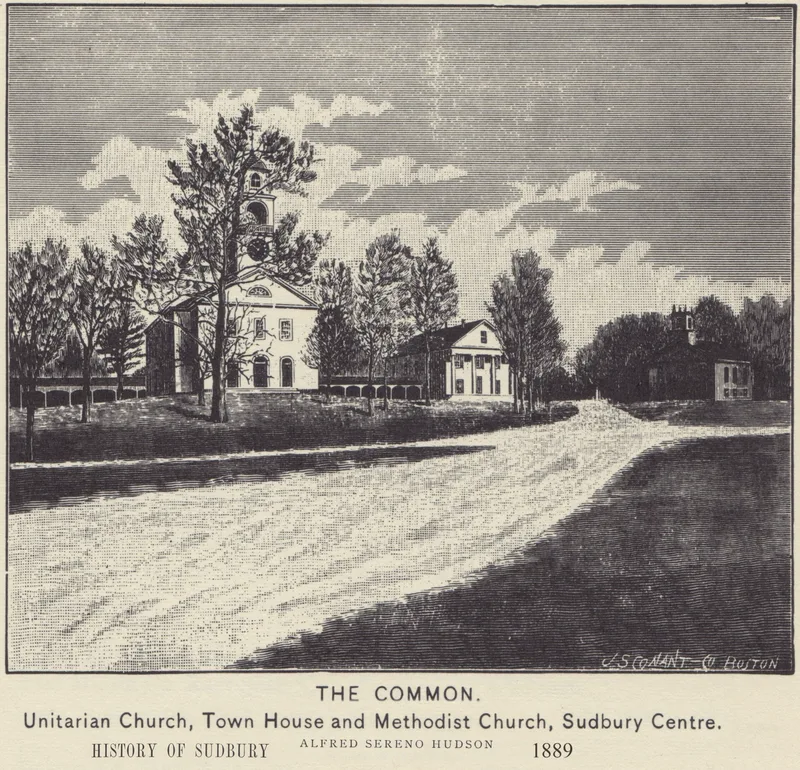
Sudbury Center is a village district of 82 structures arranged around a triangular green and along four roads that radiate from it. Clapboard construction predominates. The green is bordered by the First Parish Church of 1797, the Town Hall of 1932 by Charles H. May, a replica of an 1846 building lost to fire, the Greek Revival Grange Hall, and the Presbyterian Church. Nearby farmhouses range from the 18th century to the 20th, in Federal, Greek Revival, Mansard, Queen Anne and Colonial Revival styles. The district also contains the Ralph Adams Cram house and his Norman-style St. Elizabeth's Chapel, built in 1914 of fieldstone, plus several old cemeteries. It was listed because of its well-preserved houses and its role in local history: an early settlement of the late 1630s, the Haynes Garrison House site where settlers repelled attackers in 1676, and the green where minutemen gathered on April 19, 1775 before marching to Concord.
Significance in brief: The district is described as a fine collection of well-preserved houses representing a wide range of styles and as the center of much of Sudbury's historical development. It includes the site of an early colonial settlement from the late 1630s, the Haynes Garrison House site tied to King Philip's War in 1676, and the green where militia mustered on April 19, 1775.
Machine-generated summary. This summary was generated by a language model from the official nomination document and has not been reviewed line by line by an editor. It may contain errors. Check the source document before relying on any detail. Source: nomination document (PDF) · National Archives catalog entry. NRHP reference 76000277, listed July 14, 1976. Summary generated October 2026 (model claude-sonnet-5-5, prompt v1.0-2026-10-29, confidence medium).
Key facts
| Address | Concord and Old Sudbury Rds., Sudbury |
|---|---|
| County | Middlesex County |
| Listed | July 14, 1976 |
| Reference number | 76000277 |
| Resource type | District |
| Period of significance | 1700-1799, 1800-1899, 1900 |
| Architect / builder | Charles H. May (Town Hall, 1932); Ralph Adams Cram (wing of his house and St. Elizabeth's Chapel) |
| Architectural style | Mixed styles including Federal, Greek Revival, Mansard, Queen Anne and Colonial Revival |
| Areas of significance | Military, Architecture |
| Level of significance | Local |
| Status (as stated in the nomination) | Mix of occupied private residences, churches, government and commercial uses. The Loring Parsonage is used as town offices, and the Grange Hall has been used continuously by the Sudbury Grange since 1891. |
| Acreage | 193.6 |
| Coordinates | 42.38279, -71.41338 (NPS GIS) |
What listing means for this property
This is a historic district. Buildings within its boundary are either contributing (they add to the district's significance) or non-contributing. Owners of contributing income-producing buildings can claim the 20% federal rehabilitation tax credit; homeowners should look at state credits. National Register districts impose no design review by themselves; a local historic district ordinance, if one exists, does (the difference explained).
General information, not legal or tax advice. Rules change; confirm with your State Historic Preservation Office or a qualified adviser.
Sources and further reading
- National Park Service, National Register of Historic Places database (snapshot May 2026), reference 76000277.
- Nomination form (PDF, National Archives) — catalog entry
- Wikipedia article (used for cross-checking only; text not reproduced here)
- Wikidata Q7633501
- This listing as JSON
Last updated October 2026. Found an error? See the editorial policy for how to report it.