Spring Hill Historic District

Why it's listed
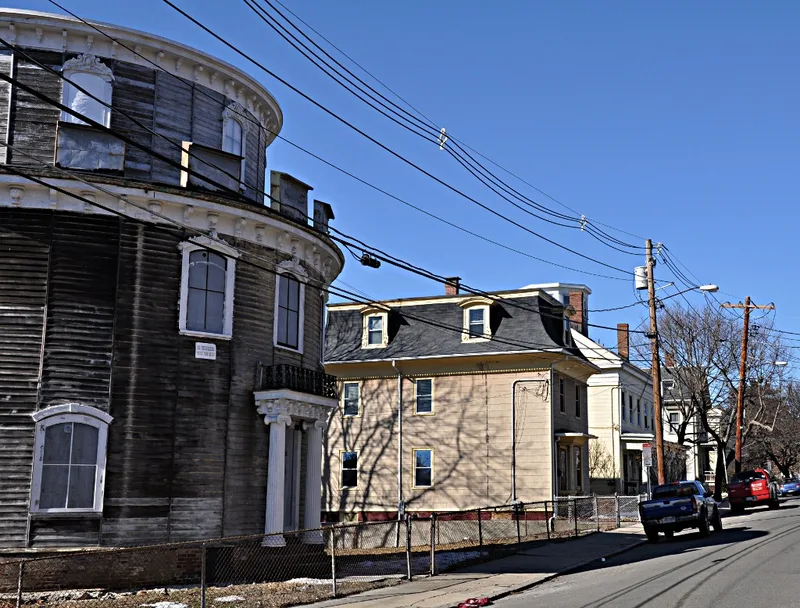
Spring Hill is a residential neighborhood in Somerville, Massachusetts, covering about 12 acres on a hill that looks south toward Cambridge. In 1843 real estate dealer George Brastow hired Alexander Wadsworth to lay out a grid of building lots around Harvard Street, and horsecar and rail service made the slope attractive to Boston and Charlestown businessmen. Eight double Greek Revival houses went up around 1845 to 1848, followed by villas, Gothic Revival cottages and the circular Round House built in 1856 by inventor Enoch Robinson. Late nineteenth-century Queen Anne and Shingle Style houses followed, including the 1895 Edward Crane House by George A. Loring. Around the turn of the century, large estates were subdivided and three-deckers and apartment buildings filled in. The district holds 69 properties, most of them contributing, and keeps its original street plan. It was listed as Somerville's largest and most intact pre-Civil War residential district.
Significance in brief: The nomination calls it Somerville's largest and most intact pre-Civil War residential district. Its success was tied to the arrival of public transportation in 1841, and its grid street plan, laid out for real estate dealer George Brastow by Alexander Wadsworth, survives. Later three-deckers and Queen Anne and Shingle Style houses were added as infill. It meets criteria A and C at the local level.
Machine-generated summary. This summary was generated by a language model from the official nomination document and has not been reviewed line by line by an editor. It may contain errors. Check the source document before relying on any detail. Source: nomination document (PDF) · National Archives catalog entry. NRHP reference 89001222, listed September 18, 1989. Summary generated October 2026 (model claude-sonnet-5-5, prompt v1.0-2026-10-29, confidence high).
Key facts
| Address | Roughly bounded by Summer, Central, Atherton, and Spring, Somerville |
|---|---|
| County | Middlesex County |
| Listed | September 18, 1989 |
| Reference number | 89001222 |
| Resource type | District |
| Architect / builder | Alexander Wadsworth (surveyor/designer of the subdivision plan); George Brastow (developer); Enoch Robinson (builder of the Round House); George A. Loring of Loring and Phipps (Edward Crane House) |
| Architectural style | Greek Revival, Gothic Revival, Italianate, Second Empire, Queen Anne, Shingle Style and Colonial Revival |
| Criteria |
|
| Areas of significance | Community Planning and Development, Architecture |
| Level of significance | Local |
| Status (as stated in the nomination) | General condition fair/good; present use residential. The Martin S. Carr School has been rehabilitated as apartments. |
| Acreage | 12 |
| Coordinates | 42.38568, -71.10835 (NPS GIS) |
What listing means for this property
This is a historic district. Buildings within its boundary are either contributing (they add to the district's significance) or non-contributing. Owners of contributing income-producing buildings can claim the 20% federal rehabilitation tax credit; homeowners should look at state credits. National Register districts impose no design review by themselves; a local historic district ordinance, if one exists, does (the difference explained).
General information, not legal or tax advice. Rules change; confirm with your State Historic Preservation Office or a qualified adviser.
Sources and further reading
- National Park Service, National Register of Historic Places database (snapshot May 2026), reference 89001222.
- Nomination form (PDF, National Archives) — catalog entry
- Wikipedia article (used for cross-checking only; text not reproduced here)
- Wikidata Q7580588
- This listing as JSON
Last updated October 2026. Found an error? See the editorial policy for how to report it.