Smith Shoe Shop

Why it's listed
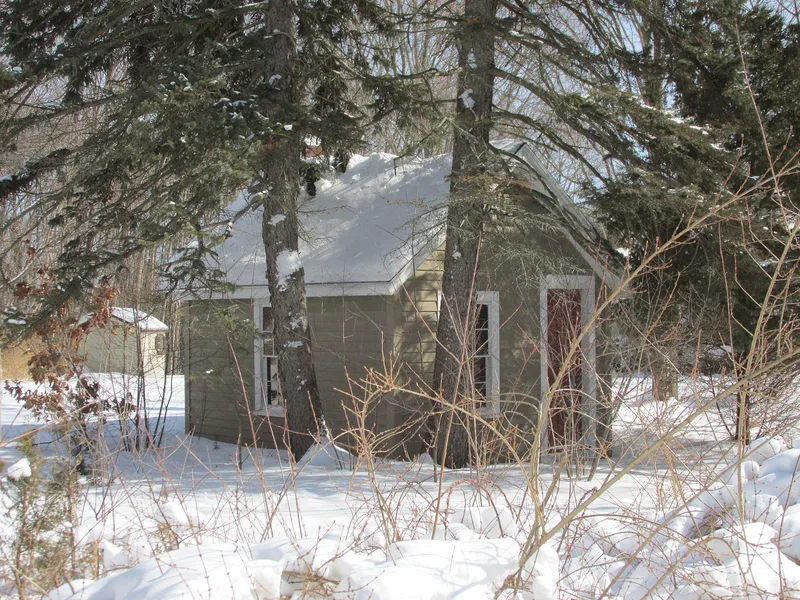
Located beside a house at 273 Haverhill Street in Reading, this small shop of about 10 by 15 feet was built around 1845, as indicated by a 1854 map and visual analysis. It is clad in clapboard and vertical board. It is one of the local "ten-footers," the nickname for the small shops that dotted the town where shoes were made by hand. Reading's shoemaking dated back to the 1700s, and by the nineteenth century nearly every family worked at binding and stretching shoes. The town specialized in dancing pumps in the 1830s and later in infant and children's shoes. After the Civil War, sewing machines moved production from cottage work to factories, and Reading lost business to towns with more factories, though it kept making shoes into the twentieth century. This shop is regarded as the best surviving example of its type and retains its location, design, materials and workmanship. It is in fair to poor condition and is used for storage.
Significance in brief: It is described as the best surviving example of the "ten-footer" shoemaking shop, a small building type that played a large role in Reading's shoe industry. The form says it keeps its integrity of location, design, materials and workmanship, and it is evaluated under Criteria A and C.
Machine-generated summary. This summary was generated by a language model from the official nomination document and has not been reviewed line by line by an editor. It may contain errors. Check the source document before relying on any detail. Source: nomination document (PDF) · National Archives catalog entry. NRHP reference 85000550, listed February 1, 1985. Summary generated October 2026 (model claude-sonnet-5-5, prompt v1.0-2026-10-29, confidence medium).
Key facts
| Address | 273 Haverhill St., Reading |
|---|---|
| County | Middlesex County |
| Listed | February 1, 1985 |
| Reference number | 85000550 |
| Resource type | Building |
| Criteria |
|
| Areas of significance | Industry, Architecture |
| Level of significance | Local |
| Status (as stated in the nomination) | Recorded in fair to poor condition; current use listed as storage. |
| Acreage | 0.3 |
| Coordinates | 42.54266, -71.08854 (NPS GIS) |
What listing means for this property
For an income-producing building, listing (individually or as a contributing building in a district) is the gateway to the 20% federal rehabilitation tax credit on qualified rehabilitation costs, often stackable with state credits. Work claiming the credit must follow the Secretary of the Interior's Standards and be approved in advance.
Listing does not restrict a private owner acting without federal money or permits; where federal funding or licensing is involved, Section 106 review applies.
General information, not legal or tax advice. Rules change; confirm with your State Historic Preservation Office or a qualified adviser.
Sources and further reading
- National Park Service, National Register of Historic Places database (snapshot May 2026), reference 85000550.
- Nomination form (PDF, National Archives) — catalog entry
- Wikipedia article (used for cross-checking only; text not reproduced here)
- Wikidata Q7545319
- This listing as JSON
Last updated October 2026. Found an error? See the editorial policy for how to report it.