Carroll-Hartshorn House

Why it's listed
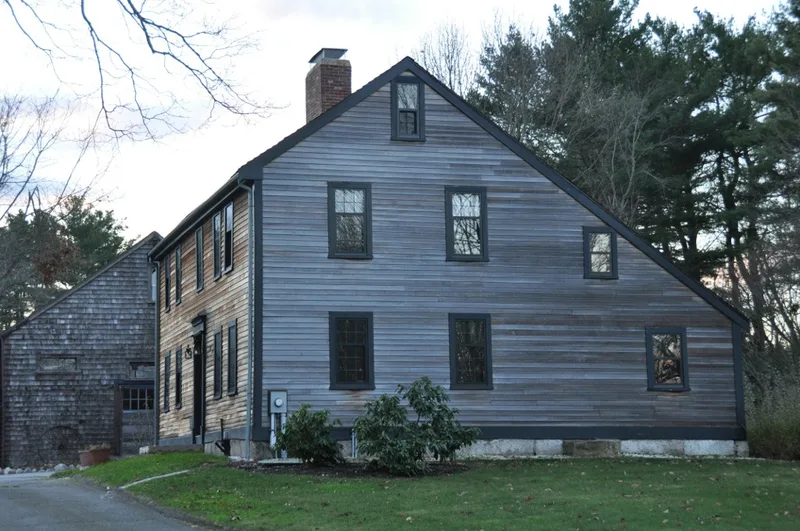
Built around 1700 at 572 Haverhill Street in Reading, this farmhouse is among the oldest buildings in town. It shows the hallmarks of First Period construction: a compact five-bay form, a central chimney and a saltbox extension. Its original front window surrounds survive, and the windows are set high and are longer than usual for early houses. The house faces south on a hill, between a swamp and a brook, and was farmed for generations by the Hartshorn family. The Pratt family owned it from 1751 to 1799 and began the Pratt presence in the Bear Meadow area, where the place was later called Pratt Row. James Weston, a shoemaker, farmer and diarist, owned it from 1799 to 1824, and his diary became a valuable source on local history and folkways. It is listed as an early farm and shoemaking homestead, for its family associations, and as one of two surviving 17th-century buildings in Reading.
Significance in brief: The house is argued to be significant as an early farm and shoemaking homestead, for its ties to the locally important Hartshorn and Pratt families, and as one of Reading's two remaining 17th-century buildings. It retains integrity of location, design, setting and feeling.
Machine-generated summary. This summary was generated by a language model from the official nomination document and has not been reviewed line by line by an editor. It may contain errors. Check the source document before relying on any detail. Source: nomination document (PDF) · National Archives catalog entry. NRHP reference 84002532, listed July 19, 1984. Summary generated October 2026 (model claude-sonnet-5-5, prompt v1.0-2026-10-29, confidence medium).
Key facts
| Address | 572 Haverhill St., Reading |
|---|---|
| County | Middlesex County |
| Listed | July 19, 1984 |
| Reference number | 84002532 |
| Resource type | Building |
| Architectural style | First Period |
| Criteria |
|
| Areas of significance | Exploration/Settlement, Architecture |
| Level of significance | Local |
| Status (as stated in the nomination) | Altered by a north extension and additions to the west and south; roof altered in 1977. A small garage with an antique shop stands to the south. |
| Acreage | 1.2 |
| Coordinates | 42.55071, -71.09636 (NPS GIS) |
What listing means for this property
National Register listing is honorary for a privately owned home: it does not by itself restrict what an owner may do with their own money, and it does not require public access. Restrictions come from local landmark or historic-district ordinances, which are separate (how they differ).
Owner-occupied houses are not eligible for the 20% federal rehabilitation tax credit, which applies to income-producing buildings, but many states offer credits for homeowners. Listing also opens the door to preservation easements and to buying a plaque. Start with what listing means for homeowners, renovating a listed house and selling one.
General information, not legal or tax advice. Rules change; confirm with your State Historic Preservation Office or a qualified adviser.
Sources and further reading
- National Park Service, National Register of Historic Places database (snapshot May 2026), reference 84002532.
- Nomination form (PDF, National Archives) — catalog entry
- Wikipedia article (used for cross-checking only; text not reproduced here)
- Wikidata Q5046503
- This listing as JSON
Last updated October 2026. Found an error? See the editorial policy for how to report it.