Pierce Organ Pipe Factory

Why it's listed
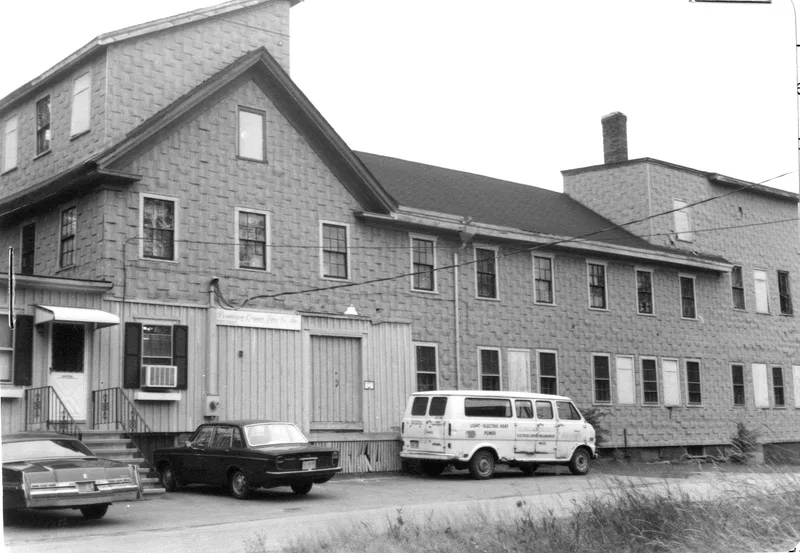
Organ pipes have been made at 10-12 Pierce Street in Reading since 1852, when Samuel Pierce opened his factory there. Pierce had trained with a local cabinet maker and with organ builders in Boston, moved to Reading in 1846, and began making metal pipes in an ell of his house the following year. The factory grew into a business that also produced other organ parts and sold to buyers in the United States, the British provinces, Jamaica and South America. By 1854 the building held 14,000 square feet of floor space and employed 50 people. The original building resembled local houses, with its gable end to the street, heavy granite foundations, eight bays and a cupola. Additions were made to the north, west and south between 1854 and 1950, and asbestos siding now covers the walls. The Dennison Company later took over and built electrically powered organs, including console organs for movie theaters. It is one of few remaining 19th-century industrial buildings in town and the only one still serving its original purpose.
Significance in brief: It is one of the few surviving 19th-century industrial buildings in Reading and the only one still used for its original purpose. It is tied to Samuel Pierce, a successful organ pipe manufacturer. It also reflects Reading's role in producing organs and organ pipes.
Machine-generated summary. This summary was generated by a language model from the official nomination document and has not been reviewed line by line by an editor. It may contain errors. Check the source document before relying on any detail. Source: nomination document (PDF) · National Archives catalog entry. NRHP reference 84002795, listed July 19, 1984. Summary generated October 2026 (model claude-sonnet-5-5, prompt v1.0-2026-10-29, confidence high).
Key facts
| Address | 10-12 Pierce St., Reading |
|---|---|
| County | Middlesex County |
| Listed | July 19, 1984 |
| Reference number | 84002795 |
| Resource type | Building |
| Architectural style | Italianate |
| Criteria |
|
| Areas of significance | Industry, Architecture |
| Level of significance | Local |
| Status (as stated in the nomination) | Still in use as an organ pipe factory; the form lists the present use as organ pipe factory. |
| Acreage | 0.9 |
| Coordinates | 42.52767, -71.09559 (NPS GIS) |
What listing means for this property
For an income-producing building, listing (individually or as a contributing building in a district) is the gateway to the 20% federal rehabilitation tax credit on qualified rehabilitation costs, often stackable with state credits. Work claiming the credit must follow the Secretary of the Interior's Standards and be approved in advance.
Listing does not restrict a private owner acting without federal money or permits; where federal funding or licensing is involved, Section 106 review applies.
General information, not legal or tax advice. Rules change; confirm with your State Historic Preservation Office or a qualified adviser.
Sources and further reading
- National Park Service, National Register of Historic Places database (snapshot May 2026), reference 84002795.
- Nomination form (PDF, National Archives) — catalog entry
- Wikipedia article (used for cross-checking only; text not reproduced here)
- Wikidata Q7191817
- This listing as JSON
Last updated October 2026. Found an error? See the editorial policy for how to report it.