Manning, Charles, House

Why it's listed
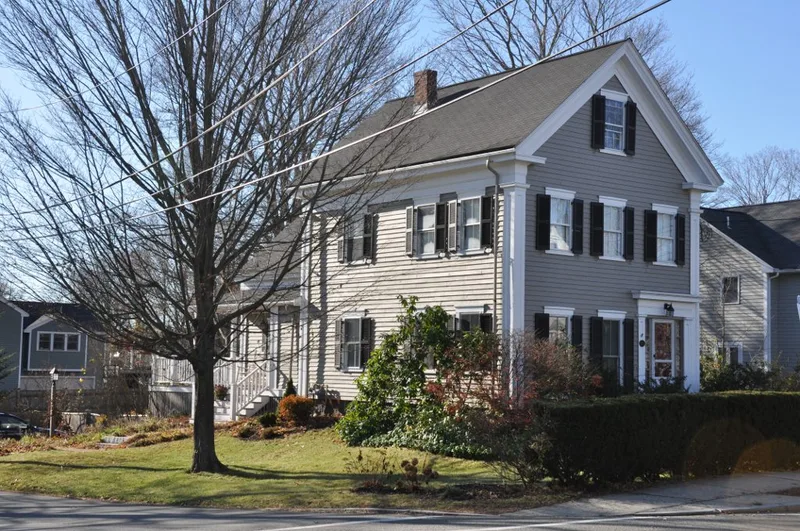
Built around 1850 at 145 Salem Street in Reading, this clapboard house was the home of Charles Manning, who lived there from 1854 to 1889. Manning made parlor desks, part of the woodworking industry that thrived on the town's east side from the 1830s to the Civil War years. He was apprenticed to Francis Kingman, later partnered with his brother Ezra Manning and Solon A. Parker, and served in the state House of Representatives in 1862. The street beside the lot carries his name. Architecturally, the house is a good example of the Greek Revival. Its three-bay front has the gable end turned to the street, echoing a classical temple, with paneled corner pilasters carrying a wide frieze along the sides. The door surround, similar to designs in American pattern books, has long sidelights, paneled pilasters and a full entablature. Shallow pedimented lintels cap the windows. Alterations are limited, with a porch noted.
Significance in brief: The evaluation cites its role in Reading's cabinet-making trade, its link to Charles Manning, a parlor desk manufacturer and state representative, and its quality as an example of Greek Revival architecture. It is said to retain integrity of design, location, setting, materials, workmanship and feeling.
Machine-generated summary. This summary was generated by a language model from the official nomination document and has not been reviewed line by line by an editor. It may contain errors. Check the source document before relying on any detail. Source: nomination document (PDF) · National Archives catalog entry. NRHP reference 84002744, listed July 19, 1984. Summary generated October 2026 (model claude-sonnet-5-5, prompt v1.0-2026-10-29, confidence medium).
Key facts
| Address | 145 Salem St., Reading |
|---|---|
| County | Middlesex County |
| Listed | July 19, 1984 |
| Reference number | 84002744 |
| Resource type | Building |
| Architectural style | Greek Revival |
| Criteria |
|
| Areas of significance | Industry, Politics/Government, Architecture |
| Level of significance | Local |
| Acreage | 0.5 |
| Coordinates | 42.52679, -71.09446 (NPS GIS) |
What listing means for this property
National Register listing is honorary for a privately owned home: it does not by itself restrict what an owner may do with their own money, and it does not require public access. Restrictions come from local landmark or historic-district ordinances, which are separate (how they differ).
Owner-occupied houses are not eligible for the 20% federal rehabilitation tax credit, which applies to income-producing buildings, but many states offer credits for homeowners. Listing also opens the door to preservation easements and to buying a plaque. Start with what listing means for homeowners, renovating a listed house and selling one.
General information, not legal or tax advice. Rules change; confirm with your State Historic Preservation Office or a qualified adviser.
Sources and further reading
- National Park Service, National Register of Historic Places database (snapshot May 2026), reference 84002744.
- Nomination form (PDF, National Archives) — catalog entry
- Wikipedia article (used for cross-checking only; text not reproduced here)
- Wikidata Q5080636
- This listing as JSON
Last updated October 2026. Found an error? See the editorial policy for how to report it.