House at 483 Summer Avenue

Why it's listed
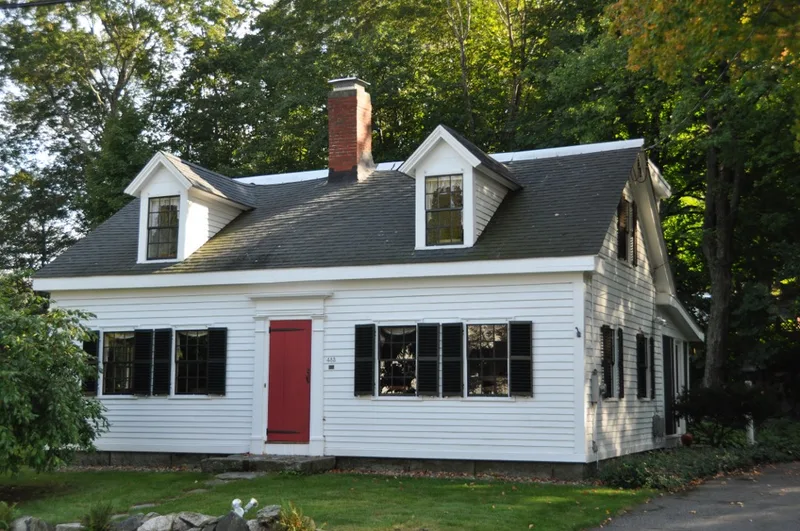
This one and one-half story, five-bay clapboard house at 483 Summer Avenue in Reading was built between 1830 and 1835. Although it dates from after 1830, it follows the Federal style, with a tall, narrow doorway surround of pilasters supporting a full entablature and projecting cornice. The form describes this house type as deeply ingrained in local building practice. An unusual chimney foundation of three parallel brick walls topped by large timbers is also noted, and it is thought to have been rebuilt at some point. The house stands at a node of settlement where Summer Avenue, Walnut Street, Hopkins Street and Main Street meet. Samuel S. Porter bought the property in 1835 and sold it in 1849 to Jonathan Heselton, a cabinetmaker whose surname was often misspelled in records. It was listed for its place in the neighborhood's development, its link to Heselton, and its intact Federal vernacular character. Ells and dormers were added in the 19th century.
Significance in brief: The nomination cites its role in a node of settlement at the junction of four major roads, its connection with longtime Reading cabinetmaker Jonathan Heselton, and its value as an intact example of Federal vernacular architecture in Reading. It retains integrity of location, design, setting, materials, workmanship and feeling.
Machine-generated summary. This summary was generated by a language model from the official nomination document and has not been reviewed line by line by an editor. It may contain errors. Check the source document before relying on any detail. Source: nomination document (PDF) · National Archives catalog entry. NRHP reference 84002652, listed July 19, 1984. Summary generated October 2026 (model claude-sonnet-5-5, prompt v1.0-2026-10-29, confidence medium).
Key facts
| Address | 483 Summer Ave., Reading |
|---|---|
| County | Middlesex County |
| Listed | July 19, 1984 |
| Reference number | 84002652 |
| Resource type | Building |
| Architectural style | Federal |
| Criteria |
|
| Areas of significance | Industry, Architecture |
| Level of significance | Local |
| Status (as stated in the nomination) | Listed as a private dwelling; 19th-century ells and dormers were added, and the form says it was probably not moved. |
| Acreage | 0.5 |
| Coordinates | 42.51065, -71.10524 (NPS GIS) |
What listing means for this property
National Register listing is honorary for a privately owned home: it does not by itself restrict what an owner may do with their own money, and it does not require public access. Restrictions come from local landmark or historic-district ordinances, which are separate (how they differ).
Owner-occupied houses are not eligible for the 20% federal rehabilitation tax credit, which applies to income-producing buildings, but many states offer credits for homeowners. Listing also opens the door to preservation easements and to buying a plaque. Start with what listing means for homeowners, renovating a listed house and selling one.
General information, not legal or tax advice. Rules change; confirm with your State Historic Preservation Office or a qualified adviser.
Sources and further reading
- National Park Service, National Register of Historic Places database (snapshot May 2026), reference 84002652.
- Nomination form (PDF, National Archives) — catalog entry
- Wikipedia article (used for cross-checking only; text not reproduced here)
- Wikidata Q5914346
- This listing as JSON
Last updated October 2026. Found an error? See the editorial policy for how to report it.