Reading Municipal Light and Power Station

Why it's listed
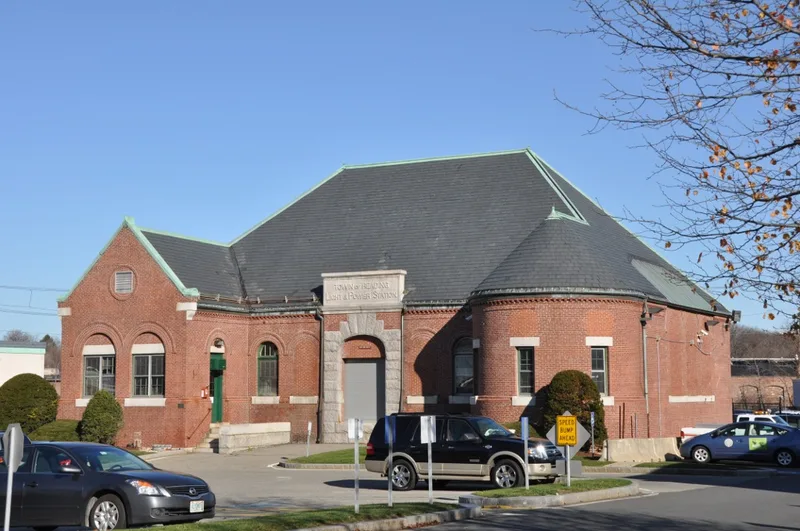
Reading's municipal light and power station on Ash Street is a small hipped-roof brick building with a slate roof, completed in 1894 and put into operation on September 26, 1895. It was designed by George E. Abbott, an architect who lived in Reading. Simple columns mark interior functions, while large windows with relieving arches and granite lintels form the main decoration, and the central door is faced in granite. The plant followed a 1891 Massachusetts act allowing cities and towns to build gas and electric plants. Reading formed study committees, chose to build rather than buy a franchise, voted a bond issue, and elected a Municipal Light and Power Board. The board built a larger building with more capable equipment than the $50,000 bond issue first covered. The plant first showed a profit on incandescent lighting in 1903 and by 1912 served North Reading, Lynnfield and Wakefield. It generated power until 1925 and now serves as an operating and switching center.
Significance in brief: It is significant for its role in the electrification of Reading and as one of the town's few examples of Romanesque architecture. It reflects the town's decision, after a 1891 state act, to build its own municipal electric plant rather than buy a franchise.
Machine-generated summary. This summary was generated by a language model from the official nomination document and has not been reviewed line by line by an editor. It may contain errors. Check the source document before relying on any detail. Source: nomination document (PDF) · National Archives catalog entry. NRHP reference 84002811, listed July 19, 1984. Summary generated October 2026 (model claude-sonnet-5-5, prompt v1.0-2026-10-29, confidence high).
Key facts
| Address | 226 Ash St., Reading |
|---|---|
| County | Middlesex County |
| Listed | July 19, 1984 |
| Reference number | 84002811 |
| Resource type | Building |
| Architect / builder | George E. Abbott |
| Architectural style | Romanesque |
| Criteria |
|
| Areas of significance | Industry, Architecture |
| Level of significance | Local |
| Status (as stated in the nomination) | Originally generated electricity until 1925; now used as an operating center and switching station. Alterations include removal of the stack, bricked-up windows (1978) and removal of railway sidings. |
| Acreage | 1.3 |
| Coordinates | 42.51812, -71.10087 (NPS GIS) |
What listing means for this property
For an income-producing building, listing (individually or as a contributing building in a district) is the gateway to the 20% federal rehabilitation tax credit on qualified rehabilitation costs, often stackable with state credits. Work claiming the credit must follow the Secretary of the Interior's Standards and be approved in advance.
Listing does not restrict a private owner acting without federal money or permits; where federal funding or licensing is involved, Section 106 review applies.
General information, not legal or tax advice. Rules change; confirm with your State Historic Preservation Office or a qualified adviser.
Sources and further reading
- National Park Service, National Register of Historic Places database (snapshot May 2026), reference 84002811.
- Nomination form (PDF, National Archives) — catalog entry
- Wikipedia article (used for cross-checking only; text not reproduced here)
- Wikidata Q7300530
- This listing as JSON
Last updated October 2026. Found an error? See the editorial policy for how to report it.