Harvard Yard Historic District
Also known as: See Also:Masssachusetts Hall; Sever Hall

Why it's listed
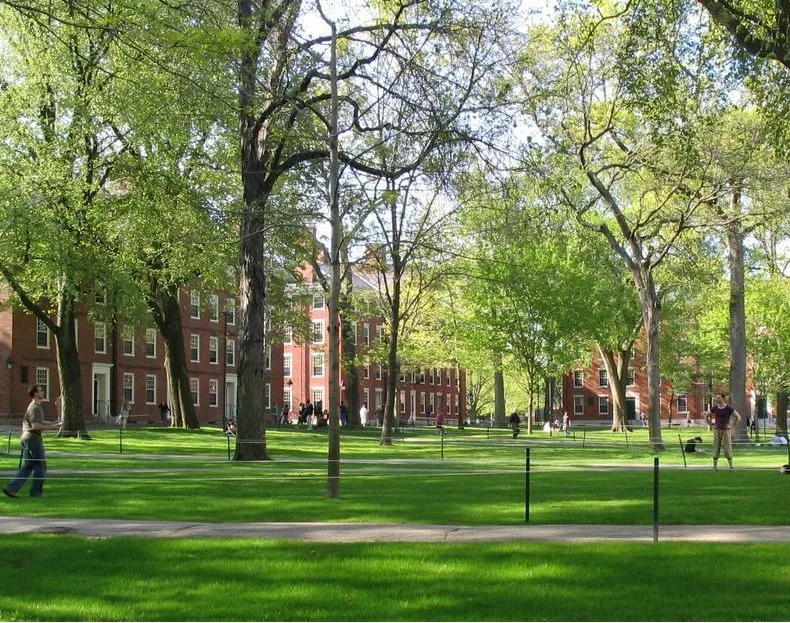
Harvard Yard is the historic core of Harvard's Cambridge campus, a 26.8-acre district of dormitories, classrooms, libraries and a church arranged around linked quadrangles and enclosed by an ornate wrought iron fence. Its oldest surviving building, Massachusetts Hall, dates from 1718, and later additions include Georgian halls, Charles Bulfinch's University Hall, H.H. Richardson's Sever Hall, and early twentieth century Neo-Georgian buildings. Widener Library and Memorial Church anchor the central Tercentenary Theatre. The district was listed as the most important evolutionary grouping of historic college buildings in the nation. Its cohesion comes from the quadrangle form, which organizes space as much as buildings, and from planning under Presidents Eliot and Lowell. It is recognized for its architecture, its place in the history of American education and campus development, its associations with notable people, and archaeological evidence of seventeenth century settlement. Postwar buildings such as Houghton, Lamont, Pusey and Canaday are not counted as contributing.
Significance in brief: The nomination calls it the most important evolutionary grouping of historic college buildings in the nation and one of the finest man-made spaces in the country. It is principally significant for architecture, with buildings by architects such as Charles Bulfinch, H.H. Richardson and McKim, Mead & White. It also relates to the history of education and campus development, to important people connected with Harvard, and to early colonial archaeology.
Machine-generated summary. This summary was generated by a language model from the official nomination document and has not been reviewed line by line by an editor. It may contain errors. Check the source document before relying on any detail. Source: nomination document (PDF) · National Archives catalog entry. NRHP reference 87002137, listed December 14, 1987. Summary generated October 2026 (model claude-sonnet-5-5, prompt v1.0-2026-10-29, confidence high).
Key facts
| Address | Roughly bounded by underpass, Broadway & Quincy Sts., Massachusetts Ave., & Peabody St., Cambridge |
|---|---|
| County | Middlesex County |
| Listed | December 14, 1987 |
| Reference number | 87002137 |
| Resource type | District |
| Period of significance | 1628-1973, but principally 1718-1930 |
| Architect / builder | Various, including Charles Bulfinch, H.H. Richardson, McKim, Mead & White, Peabody & Stearns, Horace Trumbauer, Guy Lowell, and Coolidge, Shepley, Bulfinch & Abbott |
| Architectural style | Georgian, Federal, Queen Anne, Romanesque Revival, Classical Revival and Neo-Georgian buildings, with some Modern additions |
| Criteria |
|
| Areas of significance | Education, Architecture |
| Level of significance | State |
| Status (as stated in the nomination) | Four later buildings (Houghton, Lamont, Pusey, Canaday), the 1983 Gatehouse, several gates and contemporary sculptures are listed as non-contributing because of their recent dates. |
| Acreage | 26.8 |
| Within district | Harvard Square Historic District (Boundary Increase) |
| Coordinates | 42.37372, -71.11904 (NPS GIS) |
What listing means for this property
This is a historic district. Buildings within its boundary are either contributing (they add to the district's significance) or non-contributing. Owners of contributing income-producing buildings can claim the 20% federal rehabilitation tax credit; homeowners should look at state credits. National Register districts impose no design review by themselves; a local historic district ordinance, if one exists, does (the difference explained).
General information, not legal or tax advice. Rules change; confirm with your State Historic Preservation Office or a qualified adviser.
Sources and further reading
- National Park Service, National Register of Historic Places database (snapshot May 2026), reference 87002137.
- Nomination form (PDF, National Archives) — catalog entry
- Wikipedia article (used for cross-checking only; text not reproduced here)
- Wikidata Q2838342
- This listing as JSON
Last updated October 2026. Found an error? See the editorial policy for how to report it.