Harvard Square Historic District (Boundary Increase)

Why it's listed
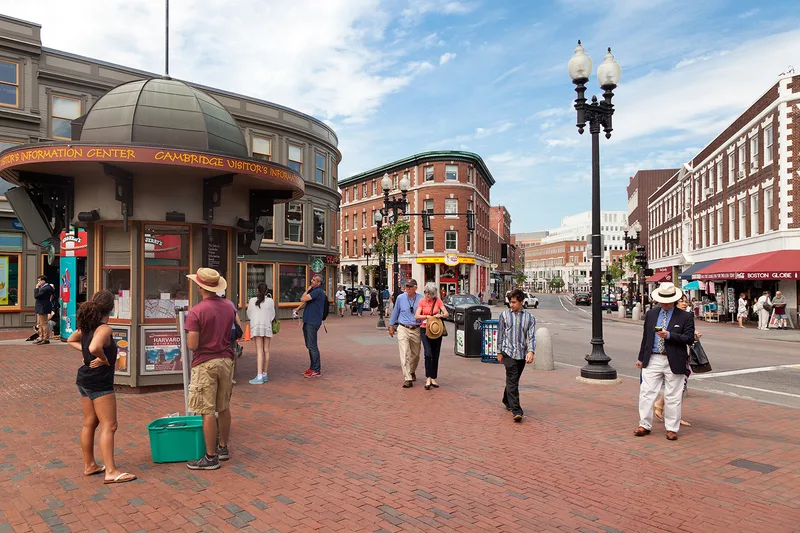
Harvard Square in Cambridge, Massachusetts, is a dense mix of shops, student housing, clubs, churches and houses, and this boundary increase adds roughly 35 acres to the existing historic district. The buildings date from 1631 to 1941. The area grew from Cambridge's 1630 grid plan, and South and Winthrop Streets still keep their original 12-foot width, along with Winthrop Square, the old marketplace. Surviving Federal and Greek Revival houses, such as the Augustus Wyeth House of 1829, show the nineteenth-century neighborhood. Later growth is shown by the Fairfax block, expanded between 1869 and 1900, and by private dormitories and clubs built from the 1880s, including the Porcellian Club and the Harvard Lampoon Building. Georgian Revival and Art Deco commercial buildings from 1908 to 1941 reflect the subway era. Reviewers found the area well documented for its historical and architectural importance and accepted it under Criteria A and C.
Machine-generated summary. This summary was generated by a language model from the official nomination document and has not been reviewed line by line by an editor. It may contain errors. Check the source document before relying on any detail. Source: nomination document (PDF) · catalog entry. Generated October 2026 (model claude-sonnet-5-5, prompt v1.0-2026-10-29).
| Period of significance | 1631-1941 |
|---|---|
| Styles | Mixed styles: Georgian, Federal, Greek Revival, Queen Anne, Colonial and Georgian Revival, Art Deco, Gothic Revival, Romanesque Revival |
| Areas of significance | Community Planning and Development, Military, Transportation, Entertainment/Recreation, Education, Architecture, Social History |
| Acreage | 35 |
| Boundary source | NPS cultural-resource GIS polygon |
| Full listing page | Harvard Square Historic District (Boundary Increase) (property record) |
What listing means for this property
This is a historic district. Buildings within its boundary are either contributing (they add to the district's significance) or non-contributing. Owners of contributing income-producing buildings can claim the 20% federal rehabilitation tax credit; homeowners should look at state credits. National Register districts impose no design review by themselves; a local historic district ordinance, if one exists, does (the difference explained).
General information, not legal or tax advice. Rules change; confirm with your State Historic Preservation Office or a qualified adviser.