Fessenden, Reginald A., House

Why it's listed
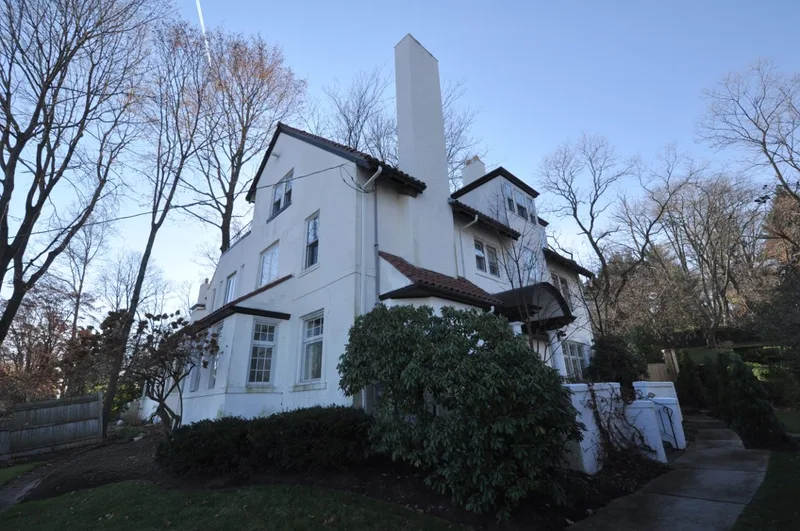
This three-story brick and stucco house at 45 Waban Hill Road, in the Chestnut Hill section of Newton, Massachusetts, was built in 1919 and served as the principal residence of inventor Reginald A. Fessenden until his death in 1932. Its vernacular design includes a tiled roof, hooded entrance, unusually large chimney, casement windows and an asymmetrical massing. The interior follows a central hall plan, and neither interior nor exterior has been altered since Fessenden's time. Fessenden, born in Quebec in 1866, worked with Thomas Edison, taught electrical engineering, and later led research at the National Electric Signalling Company. He is credited with the first transmission of speech and music in 1906, the heterodyne principle, and a rotary spark gap transmitter, among more than 300 inventions. Although he moved often and also kept a winter home in Bermuda, he lived in this house longer than anywhere else. The property was recognized for its link to his work in wireless telephony.
Significance in brief: The house is significant for its association with Reginald Fessenden, who lived there during the last 12 years of his life. Fessenden made major contributions to radio, including the first transmission of speech and music, and held over 300 inventions. The house itself is described as vernacular architecture, with its integrity intact since the Fessenden period.
Machine-generated summary. This summary was generated by a language model from the official nomination document and has not been reviewed line by line by an editor. It may contain errors. Check the source document before relying on any detail. Source: nomination document (PDF) · National Archives catalog entry. NRHP reference 76000950, listed January 7, 1976. Summary generated October 2026 (model claude-sonnet-5-5, prompt v1.0-2026-10-29, confidence high).
Key facts
| Address | 45 Waban Hill Rd., Newton |
|---|---|
| County | Middlesex County |
| Listed | January 7, 1976 |
| Reference number | 76000950 |
| Resource type | Building |
| Period of significance | 1919-1932 |
| Architectural style | Vernacular |
| Areas of significance | Science |
| Level of significance | National |
| National Historic Landmark | Yes, designated January 7, 1976 |
| Status (as stated in the nomination) | Described as in excellent condition, unrestored and unaltered since the Fessenden period; occupied as a private residence. Later designated a national historic landmark. |
| Acreage | 0.9 |
| Coordinates | 42.34041, -71.17127 (NPS GIS) |
What listing means for this property
National Register listing is honorary for a privately owned home: it does not by itself restrict what an owner may do with their own money, and it does not require public access. Restrictions come from local landmark or historic-district ordinances, which are separate (how they differ).
Owner-occupied houses are not eligible for the 20% federal rehabilitation tax credit, which applies to income-producing buildings, but many states offer credits for homeowners. Listing also opens the door to preservation easements and to buying a plaque. Start with what listing means for homeowners, renovating a listed house and selling one.
General information, not legal or tax advice. Rules change; confirm with your State Historic Preservation Office or a qualified adviser.
Sources and further reading
- National Park Service, National Register of Historic Places database (snapshot May 2026), reference 76000950.
- Nomination form (PDF, National Archives) — catalog entry
- Wikipedia article (used for cross-checking only; text not reproduced here)
- Wikidata Q7308569
- This listing as JSON
Last updated October 2026. Found an error? See the editorial policy for how to report it.