Cambridge Common Historic District (Boundary Increase and Decrease)
Also known as: See Also:Cambridge Common Historic District; Cambridge Common

Why it's listed
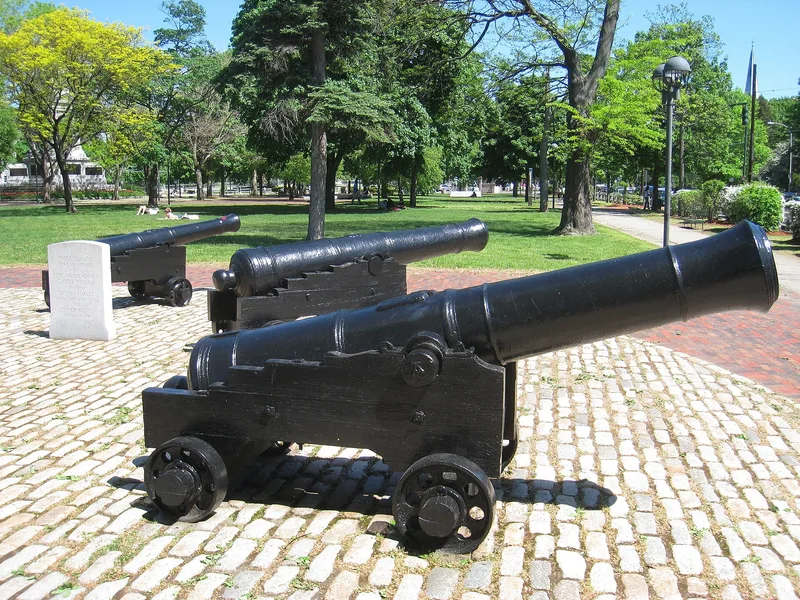
Cambridge Common is a flat, triangular park enclosed by a granite post and rail fence, surrounded by churches, university buildings, houses and early twentieth century apartment houses. It is what remains of common land set aside for public use in 1631, once reaching north to Linnaean Street. George Washington's continental army made its headquarters there in 1775-76. The fence and tree planting date from 1830, an early example of enclosing and improving a public park, and monuments were added later, including a Civil War monument, the Sumner statue by Anne Whitney, and Flagstaff Park. Nearby are Christ Church (1760), the city's oldest surviving religious structure, the Old Burying Ground (1635), and First Church, Unitarian (1833). The boundary change added Farwell Place, a dead-end street of six houses including the c. 1772 James Read House and the 1827 John Nichols House, and removed areas already covered by neighboring districts. The district is significant for settlement, the American Revolution, landscape, religion and architectural variety.
Significance in brief: The district shows about 350 years of change from open common land to an enclosed park in a dense setting, with ties to the settlement of Cambridge and the American Revolution, when the Common was George Washington's army headquarters in 1775-76. It also holds buildings of many periods and types and connections to people important to early Cambridge history.
Machine-generated summary. This summary was generated by a language model from the official nomination document and has not been reviewed line by line by an editor. It may contain errors. Check the source document before relying on any detail. Source: nomination document (PDF) · National Archives catalog entry. NRHP reference 87000499, listed January 26, 1987. Summary generated October 2026 (model claude-sonnet-5-5, prompt v1.0-2026-10-29, confidence medium).
Key facts
| Address | Roughly NW of Waterhouse St. on Concord Ave. between Garden and Follen Sts., Cambridge |
|---|---|
| County | Middlesex County |
| Listed | January 26, 1987 |
| Reference number | 87000499 |
| Resource type | District |
| Period of significance | 1770-1936 |
| Architect / builder | Isaiah Rogers (First Church, Unitarian); Peter Harrison (Christ Church); A. P. Cutting (Harvard Epworth Methodist Church); Oliver Hastings (John Nichols House); William Saunders (One Garden Street); Newhall & Blevins (apartment houses); Peabody & Stearns (Flagstaff Park flagpole base) |
| Architectural style | Mixed: Georgian, Federal, Greek Revival, Gothic Revival, Italianate, Queen Anne, Richardsonian Romanesque and Neo-Colonial |
| Criteria |
|
| Areas of significance | Landscape Architecture, Exploration/Settlement, Architecture, Religion |
| Level of significance | State |
| Status (as stated in the nomination) | General condition is stated as good. Two modern one-story buildings at 23-25 and 27-29 Church Street are noted as intrusions. |
| Acreage | 27 |
| Within district | Cambridge Common Historic District |
| Coordinates | 42.37671, -71.12058 (NPS GIS) |
What listing means for this property
This is a historic district. Buildings within its boundary are either contributing (they add to the district's significance) or non-contributing. Owners of contributing income-producing buildings can claim the 20% federal rehabilitation tax credit; homeowners should look at state credits. National Register districts impose no design review by themselves; a local historic district ordinance, if one exists, does (the difference explained).
General information, not legal or tax advice. Rules change; confirm with your State Historic Preservation Office or a qualified adviser.
Sources and further reading
- National Park Service, National Register of Historic Places database (snapshot May 2026), reference 87000499.
- Nomination form (PDF, National Archives) — catalog entry
- Wikipedia article (used for cross-checking only; text not reproduced here)
- Wikidata Q5025393
- This listing as JSON
Last updated October 2026. Found an error? See the editorial policy for how to report it.