Butterfield-Whittemore House
Also known as: Whittemore,Samuel,House

Why it's listed
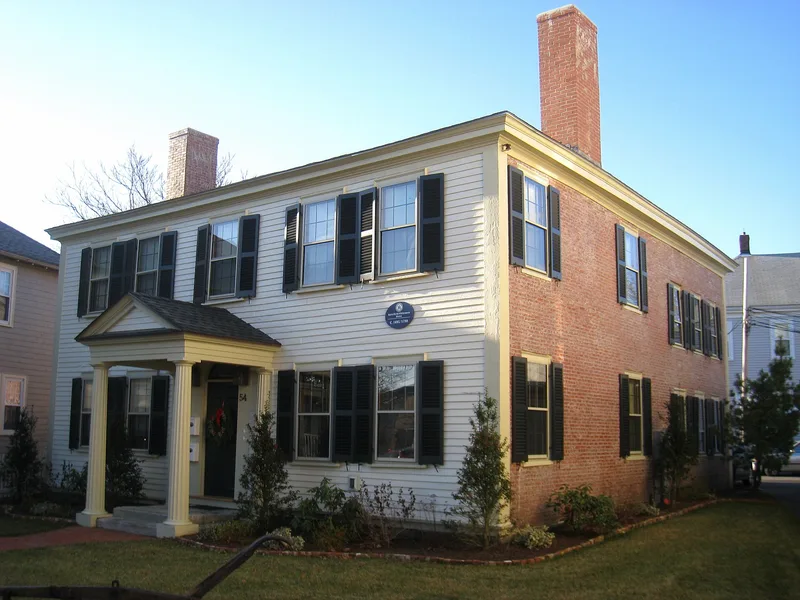
Standing at an angle to Massachusetts Avenue in Arlington, this two-story brick house with a low hip roof and granite foundation is believed to date from 1695, when Jonathan Butterfield Sr., a cordwainer, built it. The original section had a central hall and one room on each side. It was later extended to the rear and given a 1 1/2 story wing. The house once belonged to an estate of more than 80 acres and is now surrounded by 20th century residential and commercial buildings. Its importance rests on two families. The Butterfields helped establish Menotomy as a separate precinct and its church. In 1749 the farm passed to Samuel Whittemore. His relative Capt. Samuel Whittemore sniped at British soldiers during their retreat from Lexington in 1775, at almost 80 years old, and survived being bayoneted. Another descendant invented a wool card-making machine. The Whittemore land was subdivided in the early 20th century.
Significance in brief: The nomination calls it one of the oldest structures in Arlington. It is significant for its long association with two prominent families, the Butterfields and the Whittemores, who figured in the early political, military, religious and agricultural life of Arlington and Cambridge. The Whittemores include Capt. Samuel Whittemore, who fought British soldiers on April 19, 1775.
Machine-generated summary. This summary was generated by a language model from the official nomination document and has not been reviewed line by line by an editor. It may contain errors. Check the source document before relying on any detail. Source: nomination document (PDF) · National Archives catalog entry. NRHP reference 78000429, listed March 30, 1978. Summary generated October 2026 (model claude-sonnet-5-5, prompt v1.0-2026-10-29, confidence medium).
Key facts
| Address | 54 Massachusetts Ave., Arlington |
|---|---|
| County | Middlesex County |
| Listed | March 30, 1978 |
| Reference number | 78000429 |
| Resource type | Building |
| Period of significance | 1695-1729 |
| Architect / builder | Jonathan Butterfield |
| Areas of significance | Exploration/Settlement, Politics/Government |
| Level of significance | Local |
| Status (as stated in the nomination) | Listed as a private residence and occupied; condition marked good, with later additions and a 20th century setting of residential and commercial buildings. |
| Acreage | 0.2 |
| Coordinates | 42.40181, -71.13780 (NPS GIS) |
What listing means for this property
National Register listing is honorary for a privately owned home: it does not by itself restrict what an owner may do with their own money, and it does not require public access. Restrictions come from local landmark or historic-district ordinances, which are separate (how they differ).
Owner-occupied houses are not eligible for the 20% federal rehabilitation tax credit, which applies to income-producing buildings, but many states offer credits for homeowners. Listing also opens the door to preservation easements and to buying a plaque. Start with what listing means for homeowners, renovating a listed house and selling one.
General information, not legal or tax advice. Rules change; confirm with your State Historic Preservation Office or a qualified adviser.
Sources and further reading
- National Park Service, National Register of Historic Places database (snapshot May 2026), reference 78000429.
- Nomination form (PDF, National Archives) — catalog entry
- Wikipedia article (used for cross-checking only; text not reproduced here)
- Wikidata Q5002873
- This listing as JSON
Last updated October 2026. Found an error? See the editorial policy for how to report it.