Brookside Historic District

Why it's listed
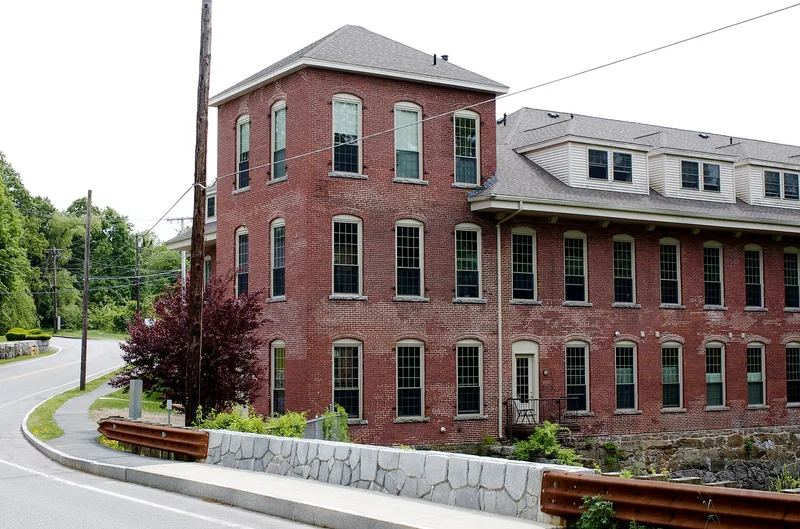
Brookside is a small mill village in Westford, Massachusetts, centered on a woolen mill beside Stony Brook. The district contains 29 historic resources: the mill with its brick tower, a ten-foot granite dam, a three-arch granite bridge, a penstock, a social club building and a range of houses. The oldest house dates to about 1725 and was likely the home of a miller. The oldest part of the mill was built of granite around 1862, and a major brick reconstruction followed in 1894 under industrialist George C. Moore, who also built six identical workers' cottages by 1895. The mill was sold to the Bigelow Carpet Company in 1911 and to the Abbot Worsted Company in 1919, which added employee housing on Coolidge Avenue. Although smaller and less intact than the mills in Forge Village and Graniteville, the complex and its surrounding company housing give the village a clear sense of place and record Westford's industrial past.
Significance in brief: The district shows the development of a small industrial village around a water-powered woolen mill on Stony Brook. It is tied to industrialist George C. Moore and later the Abbot Worsted Company, and the mill, water-power structures and company housing together illustrate 19th and early 20th century village life and the town's industrial history.
Machine-generated summary. This summary was generated by a language model from the official nomination document and has not been reviewed line by line by an editor. It may contain errors. Check the source document before relying on any detail. Source: nomination document (PDF) · National Archives catalog entry. NRHP reference 02001729, listed January 23, 2003. Summary generated October 2026 (model claude-sonnet-5-5, prompt v1.0-2026-10-29, confidence medium).
Key facts
| Address | 1-44 Brookside, 5 Moore Rd., 1-7 Coolidge Ave., Westford |
|---|---|
| County | Middlesex County |
| Listed | January 23, 2003 |
| Reference number | 02001729 |
| Resource type | District |
| Architect / builder | William C. Edwards (built the 1894 mill building, according to previous research) |
| Architectural style | Colonial, Greek Revival, Queen Anne, Victorian Eclectic, Colonial Revival |
| Areas of significance | Architecture, Community Planning and Development, Industry |
| Level of significance | Local |
| Status (as stated in the nomination) | Buildings range from poor to good condition; the 1862 granite mill section is in poor condition, and the 11 Brookside Road clubhouse is in fair condition. Several large brick industrial buildings and the railroad depot have been demolished. |
| Acreage | 25 |
| Coordinates | 42.60996, -71.41153 (NPS GIS) |
What listing means for this property
This is a historic district. Buildings within its boundary are either contributing (they add to the district's significance) or non-contributing. Owners of contributing income-producing buildings can claim the 20% federal rehabilitation tax credit; homeowners should look at state credits. National Register districts impose no design review by themselves; a local historic district ordinance, if one exists, does (the difference explained).
General information, not legal or tax advice. Rules change; confirm with your State Historic Preservation Office or a qualified adviser.
Sources and further reading
- National Park Service, National Register of Historic Places database (snapshot May 2026), reference 02001729.
- Nomination form (PDF, National Archives) — catalog entry
- Wikipedia article (used for cross-checking only; text not reproduced here)
- Wikidata Q4975109
- This listing as JSON
Last updated October 2026. Found an error? See the editorial policy for how to report it.