Bigelow, Dr. Henry Jacob, House
Also known as: Peabody School Extension
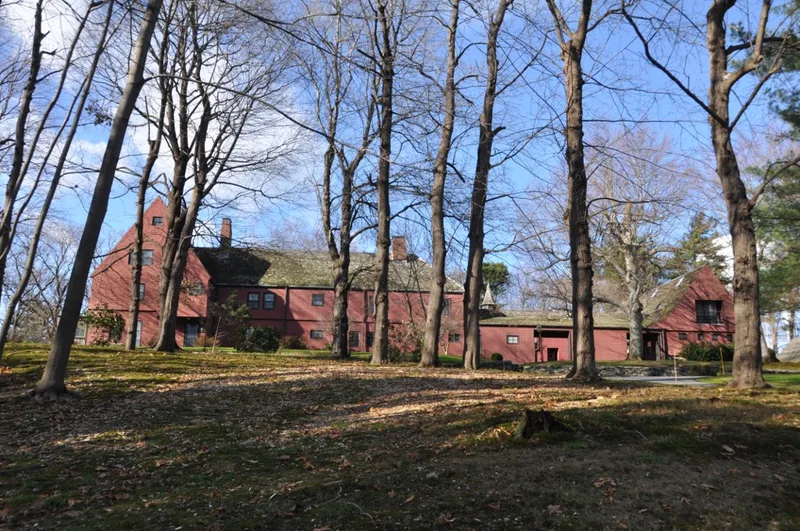

Why it's listed
Set on Oak Hill, one of Newton's highest points, this two-story shingle style house wraps around a courtyard and includes a carriage house, a small corner turret and a polygonal lantern on the rear service wing. Henry Hobson Richardson designed it in January 1886 for Dr. Henry Jacob Bigelow, and it was built the following year. Though not counted among Richardson's most outstanding shingle houses, it is his only shingle residence in Newton, and its wooded hilltop site recalls a time when the area was farms and woodland. Bigelow was a prominent surgeon and Harvard Medical School professor who, in 1846, performed the first painless operation at Massachusetts General Hospital using ether. The exterior remains nearly original apart from deterioration, while the interior was heavily altered for dormitory and classroom use by the Peabody School. The city leased the property in 1963 and later pledged better maintenance and studies of new uses.
Significance in brief: The house is among the last designs of Henry Hobson Richardson and is the only shingle-style residence by him in Newton. It is also associated with Dr. Henry Jacob Bigelow, an eminent surgeon who studied anaesthesia and performed a first painless operation at Massachusetts General Hospital in 1846.
Machine-generated summary. This summary was generated by a language model from the official nomination document and has not been reviewed line by line by an editor. It may contain errors. Check the source document before relying on any detail. Source: nomination document (PDF) · National Archives catalog entry. NRHP reference 76000266, listed January 1, 1976. Summary generated October 2026 (model claude-sonnet-5-5, prompt v1.0-2026-10-29, confidence high).
Key facts
| Address | 742 Dedham St., Newton |
|---|---|
| County | Middlesex County |
| Listed | January 1, 1976 |
| Reference number | 76000266 |
| Resource type | Building |
| Period of significance | 1800-1899 |
| Architect / builder | Henry Hobson Richardson |
| Architectural style | Shingle style |
| Areas of significance | Health/Medicine, Architecture |
| Level of significance | Local |
| Status (as stated in the nomination) | Exterior largely unchanged but showing deterioration; interior altered for dormitory and classroom use by the Peabody School; leased to the City of Newton in 1963, which allowed disrepair. The city has agreed to better maintenance and feasibility studies for alternative uses. |
| Acreage | 5 |
| Coordinates | 42.30273, -71.18637 (NPS GIS) |
What listing means for this property
National Register listing is honorary for a privately owned home: it does not by itself restrict what an owner may do with their own money, and it does not require public access. Restrictions come from local landmark or historic-district ordinances, which are separate (how they differ).
Owner-occupied houses are not eligible for the 20% federal rehabilitation tax credit, which applies to income-producing buildings, but many states offer credits for homeowners. Listing also opens the door to preservation easements and to buying a plaque. Start with what listing means for homeowners, renovating a listed house and selling one.
General information, not legal or tax advice. Rules change; confirm with your State Historic Preservation Office or a qualified adviser.
Sources and further reading
- National Park Service, National Register of Historic Places database (snapshot May 2026), reference 76000266.
- Nomination form (PDF, National Archives) — catalog entry
- Wikipedia article (used for cross-checking only; text not reproduced here)
- Wikidata Q5304145
- This listing as JSON
Last updated October 2026. Found an error? See the editorial policy for how to report it.