Lincoln-Sunset Historic District
Also known as: Millionaires' Row

Why it's listed
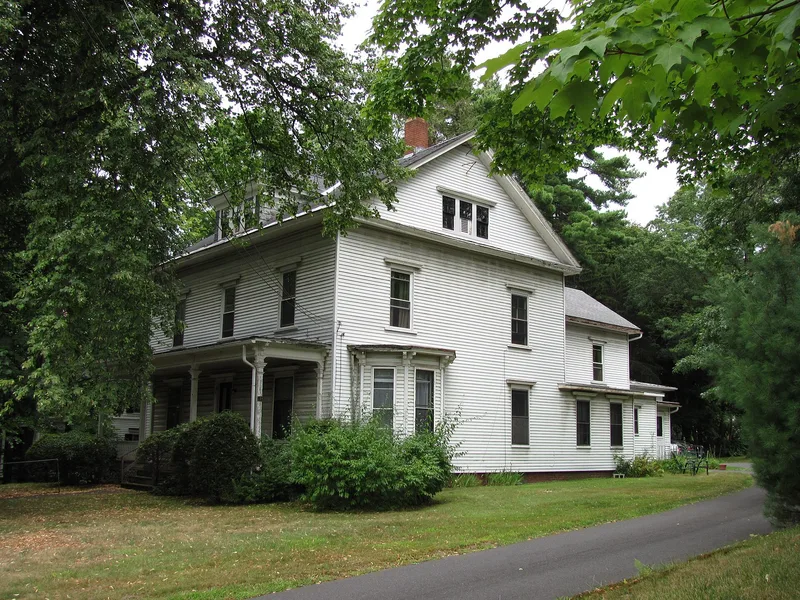
Lincoln-Sunset Historic District is a residential neighborhood of Lincoln and Sunset Avenues and part of Amity Street, two blocks west of Amherst Center in Massachusetts. Its 71 buildings are mostly large houses, with garages or barns behind, set on broad lawns under mature trees. The oldest is the Solomon Boltwood House of 1751, and the district includes Greek Revival, Gothic Revival, Italianate and Second Empire houses, along with later Colonial Revival ones. Most construction took place between 1870 and 1915, when local factories, businesses, Amherst College and the Massachusetts Agricultural College brought prosperity. Merchants, professionals and some professors built here, giving the area its nickname, Millionaire's Row. The real estate firm Westcott, Westcott and Stockbridge subdivided land into more than thirty building lots with deed restrictions that required a consistent streetscape, an early example of neighborhood planning in Amherst. The district was listed for its architecture, planning and social history, with a period of significance from 1751 to 1930.
Significance in brief: The district is argued to be significant for its architecture, its community planning and development, and its social history. It shows the homes of Amherst's successful merchants, professionals and academics. Its restricted lots, sold by a real estate firm, are described as one of the first examples of neighborhood planning in Amherst.
Machine-generated summary. This summary was generated by a language model from the official nomination document and has not been reviewed line by line by an editor. It may contain errors. Check the source document before relying on any detail. Source: nomination document (PDF) · National Archives catalog entry. NRHP reference 93000008, listed February 22, 1993. Summary generated October 2026 (model claude-sonnet-5-5, prompt v1.0-2026-10-29, confidence medium).
Key facts
| Address | Roughly, Lincoln Ave. from Northampton Rd. to Fearing St., Amherst |
|---|---|
| County | Hampshire County |
| Listed | February 22, 1993 |
| Reference number | 93000008 |
| Resource type | District |
| Period of significance | 1751-1930 |
| Architect / builder | Putnam, Karl |
| Architectural style | Greek Revival, Italianate, Colonial Revival (also Federal, Gothic Revival and Second Empire examples) |
| Criteria |
|
| Areas of significance | Community Planning and Development, Architecture, Social History |
| Level of significance | Local |
| Status (as stated in the nomination) | Residential district; houses with rear garages or barns remain in single-dwelling use. 52 contributing and 19 noncontributing buildings. |
| Acreage | 41.8 |
| Coordinates | 42.37652, -72.52485 (NPS GIS) |
What listing means for this property
This is a historic district. Buildings within its boundary are either contributing (they add to the district's significance) or non-contributing. Owners of contributing income-producing buildings can claim the 20% federal rehabilitation tax credit; homeowners should look at state credits. National Register districts impose no design review by themselves; a local historic district ordinance, if one exists, does (the difference explained).
General information, not legal or tax advice. Rules change; confirm with your State Historic Preservation Office or a qualified adviser.
Sources and further reading
- National Park Service, National Register of Historic Places database (snapshot May 2026), reference 93000008.
- Nomination form (PDF, National Archives) — catalog entry
- Wikipedia article (used for cross-checking only; text not reproduced here)
- Wikidata Q6550426
- This listing as JSON
Last updated October 2026. Found an error? See the editorial policy for how to report it.