Cushman Village Historic District
Also known as: North Amherst City
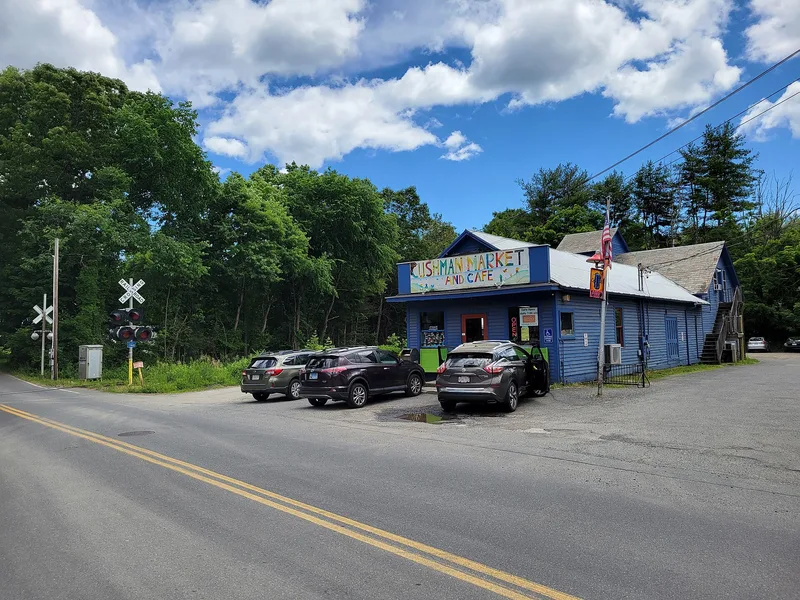

Why it's listed
Cushman Village is a compact mill settlement in northeast Amherst, Massachusetts, set along the Mill River below the Holyoke Range. Its houses are mostly modest wood-frame cottages and gable-front residences, with Greek Revival the dominant style, lasting into the 1880s. Two small Georgian-era cottages from about 1760 and 1770 are the oldest buildings. Small barns, garages and poultry sheds recall the link between farming and manufacturing. The village grew around mills that made wrapping paper, strawboard and leatherboard, run chiefly by the Cushman and Roberts families, who inventively used broom corn stalks and scrap leather. The railroad reached the village in 1866 and carried raw materials and finished goods. No mill buildings remain, but a dam, penstock, wheelhouse and foundations survive beside the river. Vacant lots and generous side yards add to the feel of a small workers' village. The district was listed for its architecture and its industrial history, with a period of significance from about 1760 to 1940.
Significance in brief: The district is significant for its architecture, its industry and its social history. It preserves a modest, conservative workers' village of mostly Greek Revival houses shaped by paper, strawboard and leatherboard mills owned by the Cushman and Roberts families. The arrival of the railroad in 1866 supported the mills and the village.
Machine-generated summary. This summary was generated by a language model from the official nomination document and has not been reviewed line by line by an editor. It may contain errors. Check the source document before relying on any detail. Source: nomination document (PDF) · National Archives catalog entry. NRHP reference 92001553, listed November 5, 1992. Summary generated October 2026 (model claude-sonnet-5-5, prompt v1.0-2026-10-29, confidence medium).
Key facts
| Address | Roughly bounded by E. Leverett Rd. and Pine, Henry, Bridge and State Sts., Amherst |
|---|---|
| County | Hampshire County |
| Listed | November 5, 1992 |
| Reference number | 92001553 |
| Resource type | District |
| Period of significance | ca. 1760-1940 |
| Architectural style | Colonial: Georgian; Mid 19th Century: Greek Revival; Late Victorian: High Victorian Gothic |
| Criteria |
|
| Areas of significance | Industry, Architecture, Social History |
| Level of significance | Local |
| Status (as stated in the nomination) | No mill buildings survive, but remains of a dam, penstock, wheelhouse and paper mill foundations are along the river. The village is described as retaining its integrity. One mill owner's house is noted as badly deteriorating. |
| Acreage | 86 |
| Coordinates | 42.41665, -72.50897 (NPS GIS) |
What listing means for this property
This is a historic district. Buildings within its boundary are either contributing (they add to the district's significance) or non-contributing. Owners of contributing income-producing buildings can claim the 20% federal rehabilitation tax credit; homeowners should look at state credits. National Register districts impose no design review by themselves; a local historic district ordinance, if one exists, does (the difference explained).
General information, not legal or tax advice. Rules change; confirm with your State Historic Preservation Office or a qualified adviser.
Sources and further reading
- National Park Service, National Register of Historic Places database (snapshot May 2026), reference 92001553.
- Nomination form (PDF, National Archives) — catalog entry
- Wikipedia article (used for cross-checking only; text not reproduced here)
- Wikidata Q5196219
- This listing as JSON
Last updated October 2026. Found an error? See the editorial policy for how to report it.