Maplewood Hotel
Also known as: Home Information Center

Why it's listed
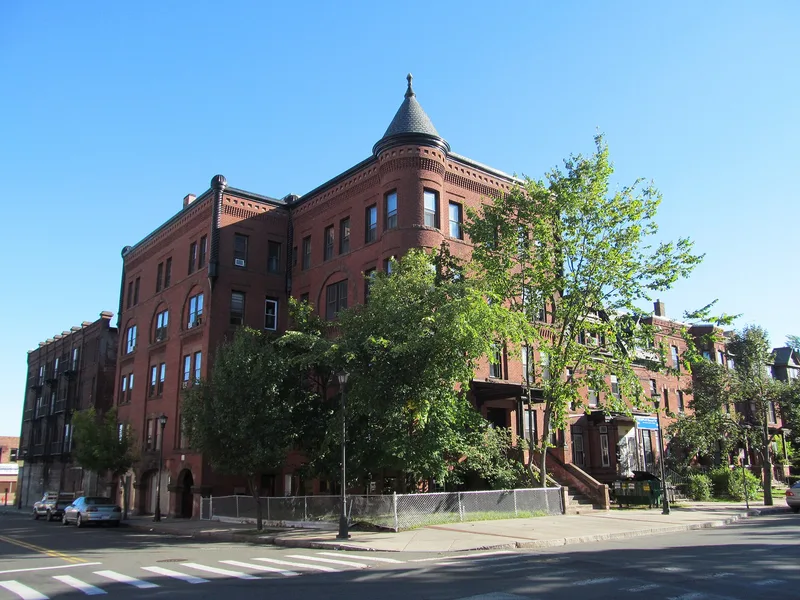
Two linked buildings on Maple Street in Holyoke, Massachusetts, form a visual anchor on a corner facing a park-like square. The larger is the Maplewood Hotel, a Romanesque Revival structure of brick with brownstone trim, built in 1889-1890. It has a turret, pressed metal cornice, arched stone entrances and storefronts on Essex Street. Next door is a Tudor Revival townhouse with half-timbering and a slate roof, which was converted to offices in 1924 and joined to the hotel in 1927, when an auditorium was added. The hotel was the city's first residential hotel, built by woolen manufacturer Frank Beebe. After retiring in 1901, Beebe turned to charity influenced by the settlement movement. He conveyed the property to social betterment organizations, and it later served the Gladden House settlement purposes through the Service League Foundation. Its architecture, its place in Holyoke's growth and its link to Beebe's philanthropy supported its listing.
Significance in brief: The nomination argues the hotel was the first residential hotel in Holyoke and is a distinguished example of its architecture. It is also tied to builder Frank Beebe, a regionally important woolen manufacturer, and to the long philanthropic use he financed. It cites criteria A, B and C.
Machine-generated summary. This summary was generated by a language model from the official nomination document and has not been reviewed line by line by an editor. It may contain errors. Check the source document before relying on any detail. Source: nomination document (PDF) · National Archives catalog entry. NRHP reference 83003980, listed November 10, 1983. Summary generated October 2026 (model claude-sonnet-5-5, prompt v1.0-2026-10-29, confidence high).
Key facts
| Address | 328-330 Maple St., Holyoke |
|---|---|
| County | Hampden County |
| Listed | November 10, 1983 |
| Reference number | 83003980 |
| Resource type | Building |
| Period of significance | 1800-1899, 1900- (specific dates 1889-90) |
| Architect / builder | Frank Beebe |
| Architectural style | Romanesque Revival (hotel) and Tudor Revival (townhouse) |
| Criteria |
|
| Areas of significance | Architecture, Social History |
| Level of significance | Local |
| Status (as stated in the nomination) | Occupied; the buildings are in good condition and unaltered, and at the time of the form housed the Home Information Center, Junior Achievement and elderly housing, with work in progress. |
| Acreage | 0.9 |
| Coordinates | 42.20370, -72.61163 (NPS GIS) |
What listing means for this property
For an income-producing building, listing (individually or as a contributing building in a district) is the gateway to the 20% federal rehabilitation tax credit on qualified rehabilitation costs, often stackable with state credits. Work claiming the credit must follow the Secretary of the Interior's Standards and be approved in advance.
Listing does not restrict a private owner acting without federal money or permits; where federal funding or licensing is involved, Section 106 review applies.
General information, not legal or tax advice. Rules change; confirm with your State Historic Preservation Office or a qualified adviser.
Sources and further reading
- National Park Service, National Register of Historic Places database (snapshot May 2026), reference 83003980.
- Nomination form (PDF, National Archives) — catalog entry
- Wikipedia article (used for cross-checking only; text not reproduced here)
- Wikidata Q1892096
- This listing as JSON
Last updated October 2026. Found an error? See the editorial policy for how to report it.