Woodbury, Peter, House

Why it's listed
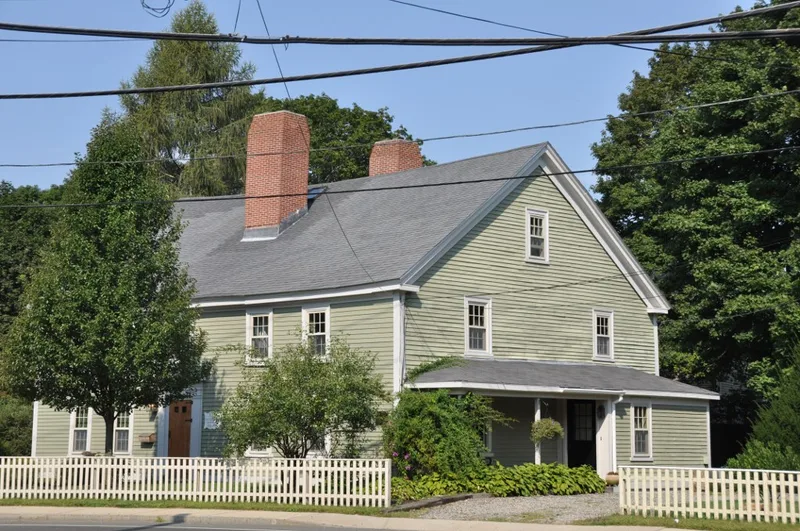
Dodge Street in Beverly is home to a house whose oldest part dates to about 1696-7. It began as a single-cell, two-and-a-half story dwelling, and later generations added the room left of the chimney, a rear lean-to later raised to full height, and a rear chimney. Today it is clapboarded, with an asymmetrical facade and two central chimneys. Inside, the second-floor chamber has paired summer beams resting on story posts with molded heads. Both beams and posts carry bevel chamfers ending in raised cove stops with pips, a rare stop type found mainly in Essex County. The ground-floor framing is boxed, and removing the boxing may reveal more decorated framing. The house is linked to Peter Woodbury Jr., a deacon active in town affairs, and his son Peter III, who marched to Concord on April 19, 1775. It is listed for its architectural integrity and its research value.
Significance in brief: The house keeps its integrity of location, materials, design and workmanship in its surviving First Period single-cell core (criterion C). Concealed framing on the ground floor may yield information about late seventeenth century decoration (criterion D). Its paired transverse summer beams and rare raised cove stops with pips are notable, and its growth shows how single-cell houses were enlarged over generations.
Machine-generated summary. This summary was generated by a language model from the official nomination document and has not been reviewed line by line by an editor. It may contain errors. Check the source document before relying on any detail. Source: nomination document (PDF) · National Archives catalog entry. NRHP reference 90000201, listed March 9, 1990. Summary generated October 2026 (model claude-sonnet-5-5, prompt v1.0-2026-10-29, confidence medium).
Key facts
| Address | 82 Dodge St., Beverly |
|---|---|
| County | Essex County |
| Listed | March 9, 1990 |
| Reference number | 90000201 |
| Resource type | Building |
| Architectural style | First Period |
| Criteria |
|
| Areas of significance | Historic - Non-Aboriginal, Architecture |
| Level of significance | State |
| Status (as stated in the nomination) | Condition described as good; in residential use, as it was originally. |
| Acreage | 0.9 |
| Coordinates | 42.57846, -70.88893 (NPS GIS) |
What listing means for this property
National Register listing is honorary for a privately owned home: it does not by itself restrict what an owner may do with their own money, and it does not require public access. Restrictions come from local landmark or historic-district ordinances, which are separate (how they differ).
Owner-occupied houses are not eligible for the 20% federal rehabilitation tax credit, which applies to income-producing buildings, but many states offer credits for homeowners. Listing also opens the door to preservation easements and to buying a plaque. Start with what listing means for homeowners, renovating a listed house and selling one.
General information, not legal or tax advice. Rules change; confirm with your State Historic Preservation Office or a qualified adviser.
Sources and further reading
- National Park Service, National Register of Historic Places database (snapshot May 2026), reference 90000201.
- Nomination form (PDF, National Archives) — catalog entry
- Wikipedia article (used for cross-checking only; text not reproduced here)
- Wikidata Q14715812
- This listing as JSON
Last updated October 2026. Found an error? See the editorial policy for how to report it.