Tufts, Rev. John, House

Why it's listed
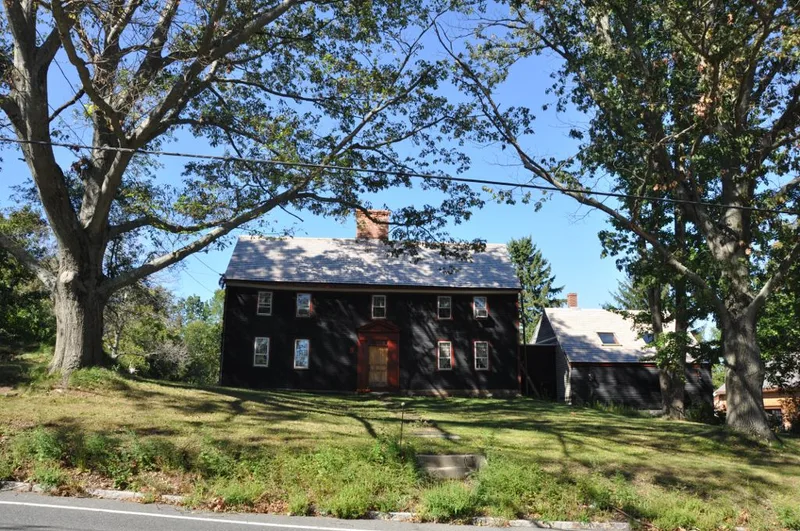
Built around 1714-1715, this house at 750 Main Street in West Newbury began as a two-story, double-cell dwelling with a central chimney and lobby entrance. It was built for the Rev. John Tufts after his ordination with the West Parish in 1714. Tufts is noted as one of the first, and by some accounts the first, to publish an introduction to singing psalm tunes by notes rather than by lining out. The oak frame is clearly of a single build and remains exposed in the four main rooms. Surviving features include flat chamfered summer beams with lamb's tongue stops, a carved post head with rolled molding, and evidence of wind braces and dovetailed collar beams. A good Second Period triple-run staircase was added later. Twentieth-century additions include a rear leanto that gives the house a saltbox profile and a gabled side addition. The house was listed for the quality of its late First Period framing and its association with Tufts.
Significance in brief: The house is argued to embody late First Period construction through its well-exposed oak frame, molded post head and decorative chamfering. It is also tied to Rev. John Tufts, who was ordained in the West Parish in 1714 and was among the first to publish an introduction to singing psalm tunes by note.
Machine-generated summary. This summary was generated by a language model from the official nomination document and has not been reviewed line by line by an editor. It may contain errors. Check the source document before relying on any detail. Source: nomination document (PDF) · National Archives catalog entry. NRHP reference 90000270, listed March 9, 1990. Summary generated October 2026 (model claude-sonnet-5-5, prompt v1.0-2026-10-29, confidence medium).
Key facts
| Address | 750 Main St., West Newbury |
|---|---|
| County | Essex County |
| Listed | March 9, 1990 |
| Reference number | 90000270 |
| Resource type | Building |
| Architectural style | First Period / Second Period |
| Criteria |
|
| Areas of significance | Architecture |
| Level of significance | State |
| Status (as stated in the nomination) | Recorded in 1986 as in good condition, in residential use, and not moved. |
| Acreage | 2 |
| Coordinates | 42.80822, -70.95620 (NPS GIS) |
What listing means for this property
National Register listing is honorary for a privately owned home: it does not by itself restrict what an owner may do with their own money, and it does not require public access. Restrictions come from local landmark or historic-district ordinances, which are separate (how they differ).
Owner-occupied houses are not eligible for the 20% federal rehabilitation tax credit, which applies to income-producing buildings, but many states offer credits for homeowners. Listing also opens the door to preservation easements and to buying a plaque. Start with what listing means for homeowners, renovating a listed house and selling one.
General information, not legal or tax advice. Rules change; confirm with your State Historic Preservation Office or a qualified adviser.
Sources and further reading
- National Park Service, National Register of Historic Places database (snapshot May 2026), reference 90000270.
- Nomination form (PDF, National Archives) — catalog entry
- Wikipedia article (used for cross-checking only; text not reproduced here)
- Wikidata Q7317682
- This listing as JSON
Last updated October 2026. Found an error? See the editorial policy for how to report it.