Newbury Historic District
Also known as: The First Parish; Upper Green

Why it's listed
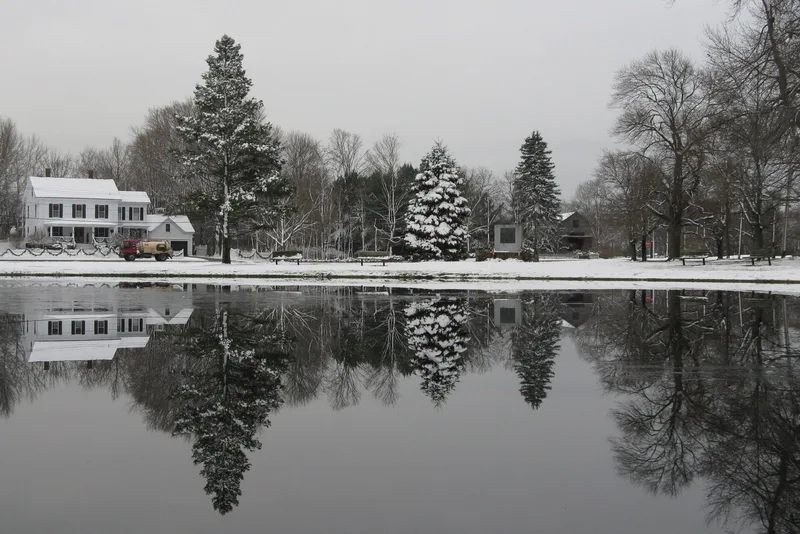
Forty buildings around the Upper Green and along High Road form the center of Newbury, Massachusetts. Nearly a third date from the seventeenth and eighteenth centuries, including the Tristram Coffin House of 1654, the Dr. Peter Toppan House of 1697, the Swett-Ilsley House begun in 1670 and the Short House of the early eighteenth century. Later houses show Federal, Greek Revival, mansard-roofed Victorian and Colonial Revival styles. Civic and institutional buildings include the First Parish Church of 1869, the Woodbridge School of 1898 and the Town Hall. The green was laid out in 1642 as a training ground and hosted a troop encampment under Benedict Arnold in 1775. The First Parish Burying Ground holds graves of early settlers. Three of the houses are now museums. Together the buildings show how the town developed from its first settlement in the 1640s through the twentieth century, and most keep a modest domestic scale.
Significance in brief: The district is significant for its fine grouping of buildings, especially its seventeenth and eighteenth century houses, and for its ties to the early development of Newbury. The area has served as the community focus since the new settlement was established in 1646. Its range of periods shows the town's growth from its beginnings to the twentieth century.
Machine-generated summary. This summary was generated by a language model from the official nomination document and has not been reviewed line by line by an editor. It may contain errors. Check the source document before relying on any detail. Source: nomination document (PDF) · National Archives catalog entry. NRHP reference 76000275, listed May 24, 1976. Summary generated October 2026 (model claude-sonnet-5-5, prompt v1.0-2026-10-29, confidence high).
Key facts
| Address | Irregular pattern along High Rd., Green and Hanover Sts., Newbury |
|---|---|
| County | Essex County |
| Listed | May 24, 1976 |
| Reference number | 76000275 |
| Resource type | District |
| Period of significance | 1600-1999 (checked periods: 1600-1699, 1700-1799, 1800-1899, 1900-) |
| Architect / builder | Col. Fred J. Coffin (First Parish Church design); Stephen Swett (Swett-Ilsley House); Nicholas Pettingill (blacksmith shop) |
| Architectural style | Mix of First Period, Georgian/colonial, Federal, Greek Revival, Victorian (mansard) and Colonial Revival buildings |
| Areas of significance | Military, Architecture |
| Level of significance | Local |
| Status (as stated in the nomination) | Condition marked good and altered; buildings continue to serve as the community center, and three houses function as house museums. |
| Acreage | 38 |
| Coordinates | 42.79820, -70.86182 (NPS GIS) |
What listing means for this property
This is a historic district. Buildings within its boundary are either contributing (they add to the district's significance) or non-contributing. Owners of contributing income-producing buildings can claim the 20% federal rehabilitation tax credit; homeowners should look at state credits. National Register districts impose no design review by themselves; a local historic district ordinance, if one exists, does (the difference explained).
General information, not legal or tax advice. Rules change; confirm with your State Historic Preservation Office or a qualified adviser.
Sources and further reading
- National Park Service, National Register of Historic Places database (snapshot May 2026), reference 76000275.
- Nomination form (PDF, National Archives) — catalog entry
- Wikipedia article (used for cross-checking only; text not reproduced here)
- Wikidata Q7017233
- This listing as JSON
Last updated October 2026. Found an error? See the editorial policy for how to report it.