Lynn Common Historic District
Also known as: See Also:Lynn Public Library; Lynn Armory; St. Stephen's Episc

Why it's listed
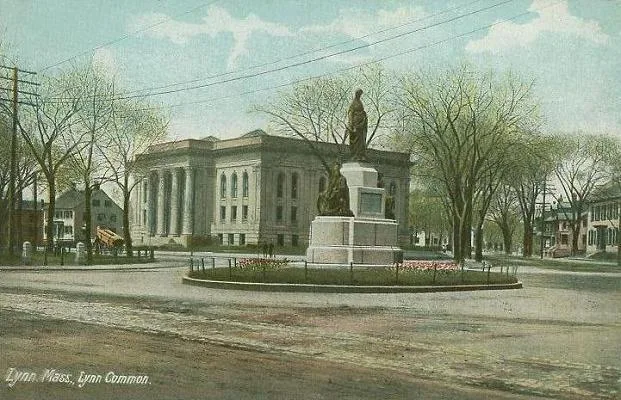
Lynn Common Historic District covers about 68 acres at the center of Lynn, Massachusetts, and centers on a park more than half a mile long, bordered by North and South Common Streets. The district includes 60 contributing resources, among them houses, apartment buildings, five churches, a library, an armory, a high school and an outlying burial ground. The Common served as a civic and religious center from the 1680s, when the first meetinghouse was built, and was cleared of buildings and landscaped as a park between the 1820s and the 1870s. It is encircled by a cast-iron fence and holds a Civil War Soldiers' Monument of 1873, a fountain and a bandstand. The surrounding architecture runs from Federal brick houses of the 1820s to Second Empire, Queen Anne and Colonial Revival buildings. Notable works include St. Stephen's Episcopal Church by Ware and Van Brunt, the Lynn Armory, and several designs by Penn Varney.
Significance in brief: The district preserves a public common used since the 17th century for civic, religious and military purposes, and it was laid out as a park from the 1820s onward. Its surrounding buildings, mostly of the mid-to-late 19th and early 20th centuries, show a broad range of architectural styles from Federal to Colonial Revival. Several works are by notable architects such as Ware and Van Brunt and Penn Varney.
Machine-generated summary. This summary was generated by a language model from the official nomination document and has not been reviewed line by line by an editor. It may contain errors. Check the source document before relying on any detail. Source: nomination document (PDF) · National Archives catalog entry. NRHP reference 92000247, listed April 10, 1992. Summary generated October 2026 (model claude-sonnet-5-5, prompt v1.0-2026-10-29, confidence medium).
Key facts
| Address | Roughly, N. and S. Common St. from Market Sq. to City Hall, Lynn |
|---|---|
| County | Essex County |
| Listed | April 10, 1992 |
| Reference number | 92000247 |
| Resource type | District |
| Architect / builder | Ware and Van Brunt; Penn Varney; Henry W. Rogers; Wheeler and Northend; George A. Moore; Sanborn and Weed; John Stevens; Edwin Earp and Son; B. H. Davidson; sculptor John A. Jackson |
| Architectural style | Federal, Greek Revival, Italianate, Second Empire, Queen Anne, Shingle Style, Romanesque Revival, Gothic Revival, Renaissance Revival, Classical Revival, Colonial Revival |
| Areas of significance | Community Planning and Development, Architecture |
| Level of significance | Local |
| Status (as stated in the nomination) | Most buildings are largely intact; the common is still a landscaped park with a fence, monuments, bandstand and fountain, and the 1893 fountain is unused. Buildings remain in residential, institutional and commercial use. |
| Acreage | 68 |
| Coordinates | 42.46385, -70.95611 (NPS GIS) |
What listing means for this property
This is a historic district. Buildings within its boundary are either contributing (they add to the district's significance) or non-contributing. Owners of contributing income-producing buildings can claim the 20% federal rehabilitation tax credit; homeowners should look at state credits. National Register districts impose no design review by themselves; a local historic district ordinance, if one exists, does (the difference explained).
General information, not legal or tax advice. Rules change; confirm with your State Historic Preservation Office or a qualified adviser.
Sources and further reading
- National Park Service, National Register of Historic Places database (snapshot May 2026), reference 92000247.
- Nomination form (PDF, National Archives) — catalog entry
- Wikipedia article (used for cross-checking only; text not reproduced here)
- Wikidata Q6708978
- This listing as JSON
Last updated October 2026. Found an error? See the editorial policy for how to report it.