First Religious Society Church and Parish Hall
Also known as: Unitarian Church and Parish Hall

Why it's listed
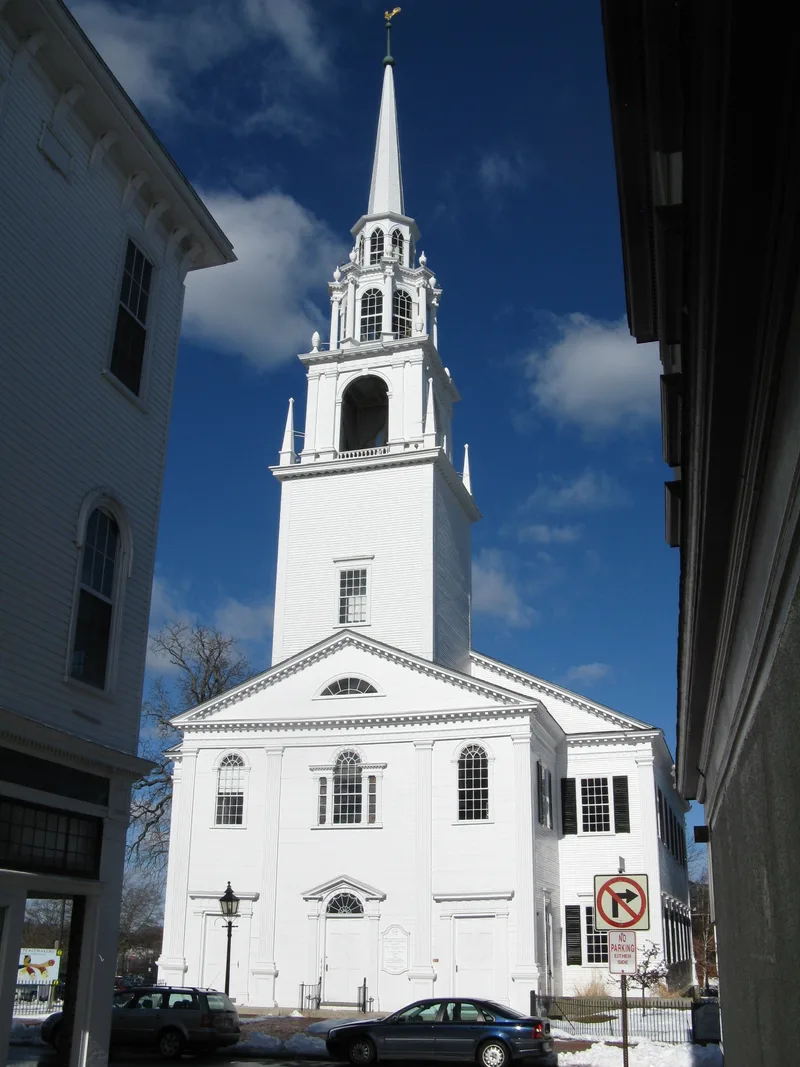
Built and dedicated in 1801, this two-story clapboard church on Pleasant Street in downtown Newburyport replaced an earlier, more modest meeting house that stood in nearby Market Square. Its design echoes the work of Samuel McIntire of Salem, and one historian has suggested Timothy Palmer as its designer, though the architect is not known for certain. The facade has a central entrance with fanlight and pediment, a Palladian window above, and a tall spire. Inside, box pews, a Palladian motif behind the pulpit and Corinthian pilasters survive, along with changes made in 1839 to the pulpit. A Parish Hall of 1873 stands next door and repeats the white clapboards, shuttered windows and fluted corner pilasters. The congregation's first minister, John Lowell, came from a prominent family, and Thomas Wentworth Higginson later served the church. Its 1834 organ, an eighteenth-century clock and early communion silver add to its interest.
Significance in brief: The nomination argues the church is a fine example of Federal architecture, with elegant detail in the central entry and Palladian window. It is also noted for its associations with distinguished Newburyport and Massachusetts citizens, including its first minister John Lowell and later minister Thomas Wentworth Higginson. The church also holds notable furnishings such as an 1834 organ and early silver.
Machine-generated summary. This summary was generated by a language model from the official nomination document and has not been reviewed line by line by an editor. It may contain errors. Check the source document before relying on any detail. Source: nomination document (PDF) · National Archives catalog entry. NRHP reference 76000278, listed April 2, 1976. Summary generated October 2026 (model claude-sonnet-5-5, prompt v1.0-2026-10-29, confidence high).
Key facts
| Address | 26 Pleasant St., Newburyport |
|---|---|
| County | Essex County |
| Listed | April 2, 1976 |
| Reference number | 76000278 |
| Resource type | Building |
| Period of significance | 1800-1899 |
| Architect / builder | Attributed to Timothy Palmer (architect unknown; Joseph Alley built the 1834 organ) |
| Architectural style | Federal |
| Areas of significance | Architecture |
| Level of significance | Local |
| Status (as stated in the nomination) | Occupied and in use as a religious property; condition listed as excellent, with exterior virtually unchanged and minor interior alterations. |
| Acreage | 0.6 |
| Within district | Newburyport Historic District |
| Coordinates | 42.81081, -70.87128 (NPS GIS) |
What listing means for this property
Religious properties are listed for their architectural or historical significance, not their religious use. Listing is honorary and does not restrict the congregation's use of the building. The federal rehabilitation credit is generally unavailable unless part of the building is income-producing; some state programmes and preservation grants do cover religious buildings. Federal funding or permits trigger Section 106 review.
General information, not legal or tax advice. Rules change; confirm with your State Historic Preservation Office or a qualified adviser.
Sources and further reading
- National Park Service, National Register of Historic Places database (snapshot May 2026), reference 76000278.
- Nomination form (PDF, National Archives) — catalog entry
- Wikipedia article (used for cross-checking only; text not reproduced here)
- Wikidata Q5453750
- This listing as JSON
Last updated October 2026. Found an error? See the editorial policy for how to report it.