Abbot Tavern
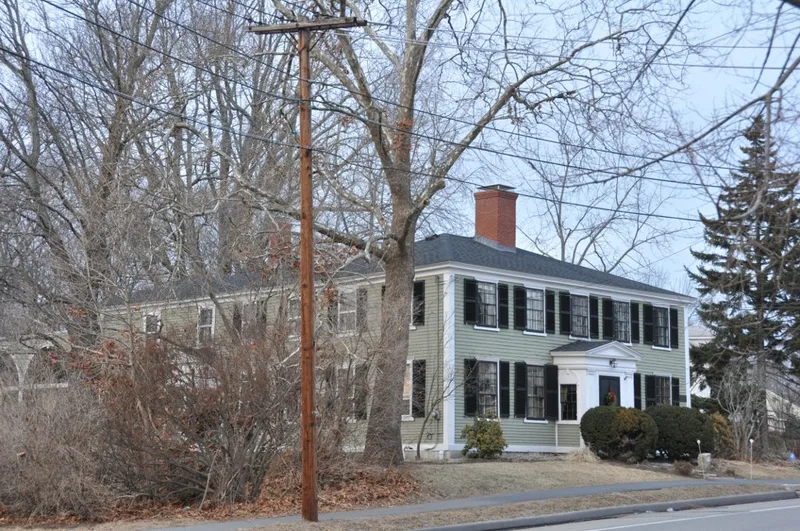

Why it's listed
Located at 70 Elm Street in Andover, this clapboard house may date to as early as 1680, though its style points to a much later period, and it first appears in the records in 1776. That year Isaac Abbot, a storekeeper, petitioned to keep a house of general entertainment for travelers on the old stage road. The tavern became locally famous when George Washington visited in 1789, shortly after his inauguration. In 1795 it became Andover's first post office, with Abbot serving as postmaster until 1825. He also held posts as selectman, town clerk and deacon. The building is two stories with a hip roof, a five-bay facade, large windows, a center chimney and a pedimented vestibule with classical trim and fluted pilasters. It is valued for its early tavern and post office roles, its link to the Abbot family, and its Georgian design. It remains a residence today.
Significance in brief: It is significant for its early use as a tavern, which George Washington visited in 1789, and as Andover's first post office. It is also tied to the locally prominent Abbot family and is a fine example of Georgian architecture in Andover. The property retains integrity of design, materials, workmanship and setting.
Machine-generated summary. This summary was generated by a language model from the official nomination document and has not been reviewed line by line by an editor. It may contain errors. Check the source document before relying on any detail. Source: nomination document (PDF) · National Archives catalog entry. NRHP reference 82004810, listed June 10, 1982. Summary generated October 2026 (model claude-sonnet-5-5, prompt v1.0-2026-10-29, confidence medium).
Key facts
| Address | 70 Elm St., Andover |
|---|---|
| County | Essex County |
| Listed | June 10, 1982 |
| Reference number | 82004810 |
| Resource type | Building |
| Architectural style | Georgian |
| Criteria |
|
| Areas of significance | Community Planning and Development, Architecture |
| Level of significance | State |
| Status (as stated in the nomination) | Present use is residential. |
| Acreage | 0.9 |
| Coordinates | 42.66425, -70.91739 (NPS GIS) |
What listing means for this property
For an income-producing building, listing (individually or as a contributing building in a district) is the gateway to the 20% federal rehabilitation tax credit on qualified rehabilitation costs, often stackable with state credits. Work claiming the credit must follow the Secretary of the Interior's Standards and be approved in advance.
Listing does not restrict a private owner acting without federal money or permits; where federal funding or licensing is involved, Section 106 review applies.
General information, not legal or tax advice. Rules change; confirm with your State Historic Preservation Office or a qualified adviser.
Sources and further reading
- National Park Service, National Register of Historic Places database (snapshot May 2026), reference 82004810.
- Nomination form (PDF, National Archives) — catalog entry
- Wikipedia article (used for cross-checking only; text not reproduced here)
- Wikidata Q4664210
- This listing as JSON
Last updated October 2026. Found an error? See the editorial policy for how to report it.