Stone House

Why it's listed
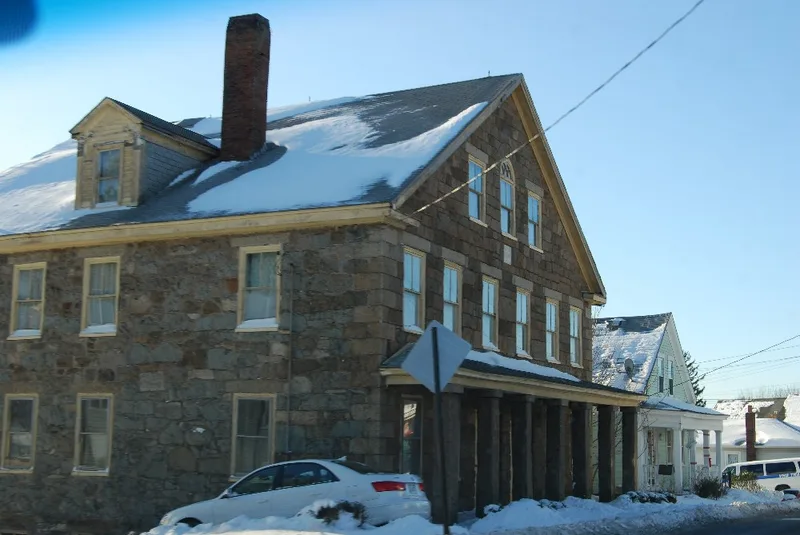
Built in 1847 at 15-17 Plain Street in Taunton's Weir Village, the Stone House is a monumentally scaled Greek Revival building made of coursed and uncoursed stone blocks. It was financed by G.W. Williams, a prominent Weir landowner from the family of early brick manufacturers, as a hostelry for sailors and others in the sea merchant trade. After Williams declared bankruptcy in 1867, he sold it to William H. Phillips, a Weir industrialist who ran a shipping and coal business in partnership with Sylvanus N. Staples. The broad-gabled, central-hall structure rises two and a half stories. Its stone facade carries a one-story porch with square granite piers, two entrances with narrow partial sidelights, stone lintels over 2/1 sash windows, and a central gable window with a round-arched transom and intersecting tracery. Along with the Stone Cottage at 66 Winthrop Street, it is one of only two stone residences from the city's Greek Revival period.
Significance in brief: It is described as one of the outstanding architectural elements of Weir Village and an extraordinary example of Greek Revival design. It and the Stone Cottage at 66 Winthrop Street are the only surviving stone residential buildings from the Greek Revival period in Taunton. It is also tied to two prominent Weir industrialists and to the city's 19th-century shipping economy.
Machine-generated summary. This summary was generated by a language model from the official nomination document and has not been reviewed line by line by an editor. It may contain errors. Check the source document before relying on any detail. Source: nomination document (PDF) · National Archives catalog entry. NRHP reference 84002219, listed July 5, 1984. Summary generated October 2026 (model claude-sonnet-5-5, prompt v1.0-2026-10-29, confidence medium).
Key facts
| Address | 15-17 Plain St., Taunton |
|---|---|
| County | Bristol County |
| Listed | July 5, 1984 |
| Reference number | 84002219 |
| Resource type | Building |
| Architectural style | Greek Revival |
| Criteria |
|
| Areas of significance | Architecture |
| Level of significance | Local |
| Status (as stated in the nomination) | Present use is residence; the form reports no alterations and no moving of the building. |
| Acreage | 0.6 |
| Coordinates | 41.88494, -71.08757 (NPS GIS) |
What listing means for this property
National Register listing is honorary for a privately owned home: it does not by itself restrict what an owner may do with their own money, and it does not require public access. Restrictions come from local landmark or historic-district ordinances, which are separate (how they differ).
Owner-occupied houses are not eligible for the 20% federal rehabilitation tax credit, which applies to income-producing buildings, but many states offer credits for homeowners. Listing also opens the door to preservation easements and to buying a plaque. Start with what listing means for homeowners, renovating a listed house and selling one.
General information, not legal or tax advice. Rules change; confirm with your State Historic Preservation Office or a qualified adviser.
Sources and further reading
- National Park Service, National Register of Historic Places database (snapshot May 2026), reference 84002219.
- Nomination form (PDF, National Archives) — catalog entry
- Wikipedia article (used for cross-checking only; text not reproduced here)
- Wikidata Q7618963
- This listing as JSON
Last updated October 2026. Found an error? See the editorial policy for how to report it.