Stafford Mills

Why it's listed
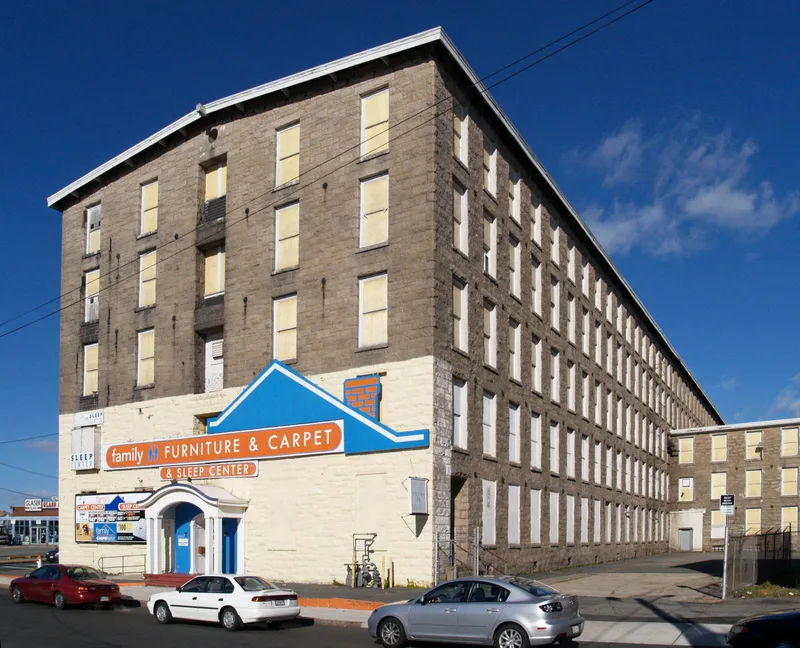
Stafford Mills is a textile complex at County and Quarry Streets in Fall River, Massachusetts, laid out on a site originally 15 acres near the Quequechan River. Two five-story granite mills, built in 1872 and 1888, face each other across a mill yard, with picker, boiler and engine houses and a two-story granite weave shed added around them. In 1896 a brick office with brownstone trim and a Syrian-arched entrance was placed at the front center of the yard, giving it a visual focus. The company was named for founder Foster H. Stafford and was one of 15 textile corporations founded in 1871 and 1872, when the city was rapidly expanding its manufacturing. The first mill held 34,928 spindles and 860 looms and produced print cloth. Instead of building tenements, the company loaned money to local landowners and leased 144 houses. The mills closed in 1929. The complex was listed for its monumental design and its place in the city's 1870s industrial growth. Some original sash has been removed and office windows partly blocked.
Significance in brief: The complex is argued to meet criteria A and C for the distinctive, monumental design of its mills and office and for its role in Fall River's industrial expansion in the 1870s. It is notable for its site plan, workmanship, harmony of proportions and largely intact quality. The 1896 Richardsonian Romanesque office is described as among the finest of the city's mill offices and unique in its use of that style.
Machine-generated summary. This summary was generated by a language model from the official nomination document and has not been reviewed line by line by an editor. It may contain errors. Check the source document before relying on any detail. Source: nomination document (PDF) · National Archives catalog entry. NRHP reference 83000718, listed February 16, 1983. Summary generated October 2026 (model claude-sonnet-5-5, prompt v1.0-2026-10-29, confidence high).
Key facts
| Address | County St., Fall River |
|---|---|
| County | Bristol County |
| Listed | February 16, 1983 |
| Reference number | 83000718 |
| Resource type | Building |
| Period of significance | 1872-1896 |
| Architect / builder | Beattie & Cornell (contractor for the office) |
| Architectural style | Richardsonian Romanesque (office); granite mill construction |
| Criteria |
|
| Areas of significance | Architecture, Communications |
| Level of significance | State |
| Status (as stated in the nomination) | Mill #1 is used as a furniture showroom; Mill #2 houses light industry and is partly vacant. The mills closed in 1929. |
| Acreage | 7 |
| Coordinates | 41.69617, -71.13873 (NPS GIS) |
What listing means for this property
National Register listing is honorary: it recognises significance and does not restrict what a private owner may do without federal money or permits. It unlocks the 20% federal rehabilitation tax credit for income-producing buildings, state credits in many states, and Section 106 review when federal agencies are involved. See what listing means in practice.
General information, not legal or tax advice. Rules change; confirm with your State Historic Preservation Office or a qualified adviser.
Sources and further reading
- National Park Service, National Register of Historic Places database (snapshot May 2026), reference 83000718.
- Nomination form (PDF, National Archives) — catalog entry
- Wikipedia article (used for cross-checking only; text not reproduced here)
- Wikidata Q7596643
- This listing as JSON
Last updated October 2026. Found an error? See the editorial policy for how to report it.