Pilgrim Mills

Why it's listed
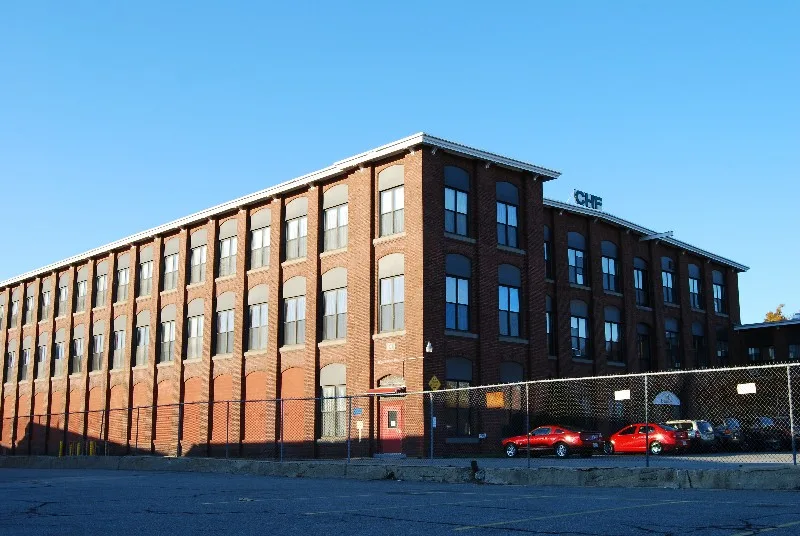
Pilgrim Mills is a brick textile complex at 847 Pleasant Street in Fall River, built in 1911 on the northern bank of the Quequechan River. Its three-story spinning mill follows the English Plan, with a low-pitched roof and wide proportions of 315 by 132 feet. A directly attached weave shed brings the total length to nearly 600 feet, among the longest in the city. Other buildings include a picker house, storehouse, boiler house and pump house, all built by the contractor Beattie and Cornell. Segmental brick relieving arches, arched sash windows and an 80-foot tile chimney, probably the only one of its kind in the city, give the site a unified look. The company was incorporated in 1910 and financed by the Draper Corporation of Hopedale, makers of the Northrop loom. It was the first fine goods mill in Fall River to install many automatic looms. It closed in 1941 and later housed a curtain manufacturer.
Significance in brief: The complex is argued to be significant as one of the last mill complexes built in Fall River and the city's best example of 20th century brick mill architecture. It was also notable as the first fine goods mill in the city to use a significant number of Northrop automatic looms, and it was financed and organized by the Draper Corporation. It meets Criteria A and C.
Machine-generated summary. This summary was generated by a language model from the official nomination document and has not been reviewed line by line by an editor. It may contain errors. Check the source document before relying on any detail. Source: nomination document (PDF) · National Archives catalog entry. NRHP reference 83000704, listed February 16, 1983. Summary generated October 2026 (model claude-sonnet-5-5, prompt v1.0-2026-10-29, confidence high).
Key facts
| Address | 847 Pleasant St., Fall River |
|---|---|
| County | Bristol County |
| Listed | February 16, 1983 |
| Reference number | 83000704 |
| Resource type | Building |
| Period of significance | 1911 |
| Architect / builder | Beattie and Cornell (contractor) |
| Architectural style | 20th century brick mill architecture ("English Plan" spinning mill) |
| Criteria |
|
| Areas of significance | Industry, Architecture |
| Level of significance | State |
| Status (as stated in the nomination) | The complex closed as a textile mill in 1941 and became a curtain manufactory in the 1950s, a use that continues. The tile chimney remains virtually intact. |
| Acreage | 7.2 |
| Coordinates | 41.69897, -71.15096 (NPS GIS) |
What listing means for this property
National Register listing is honorary: it recognises significance and does not restrict what a private owner may do without federal money or permits. It unlocks the 20% federal rehabilitation tax credit for income-producing buildings, state credits in many states, and Section 106 review when federal agencies are involved. See what listing means in practice.
General information, not legal or tax advice. Rules change; confirm with your State Historic Preservation Office or a qualified adviser.
Sources and further reading
- National Park Service, National Register of Historic Places database (snapshot May 2026), reference 83000704.
- Nomination form (PDF, National Archives) — catalog entry
- Wikipedia article (used for cross-checking only; text not reproduced here)
- Wikidata Q7193944
- This listing as JSON
Last updated October 2026. Found an error? See the editorial policy for how to report it.