Old Colony Iron Works-Nesmasket Mills Complex

Why it's listed
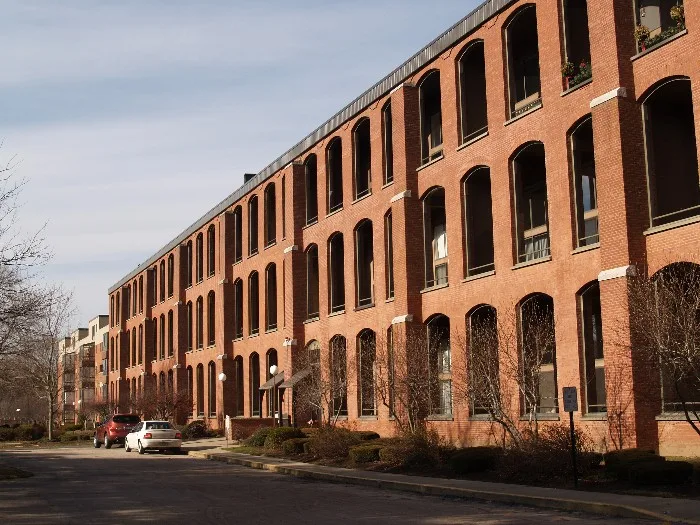
Along the Taunton River in East Taunton, this group of brick mill buildings records nearly a century of continuous industry. It began in 1813, when farmer Stephen King dammed the river to power a corn mill. By 1824 new owners had moved the dam to its present location and built an iron forge. A nail and shovel factory and rolling mill followed in 1829, and the Old Colony Iron Company was incorporated in 1844. A fire in 1881 destroyed the rolling mill and nail factory but spared the shovel shop, and the company closed. The Nemasket Mills, a cotton manufacturer, then built a 400-foot, three-story brick mill in 1892. The shovel mill was raised from two stories to four and rented to an oil cloth works. A Georgian Revival office was added around 1910. Textile production continued until the 1930s, after which tenant industries took over. The complex is valued as one of Taunton's oldest mill sites, with its original character largely intact.
Significance in brief: The complex is described as East Taunton's oldest and longest-lived industrial network, which turned an 18th-century farming settlement into a manufacturing village. It keeps integrity of location, design, setting, materials and workmanship, and reflects Taunton's growth as a major 19th-century manufacturing centre. It meets criteria A and C.
Machine-generated summary. This summary was generated by a language model from the official nomination document and has not been reviewed line by line by an editor. It may contain errors. Check the source document before relying on any detail. Source: nomination document (PDF) · National Archives catalog entry. NRHP reference 84002190, listed July 5, 1984. Summary generated October 2026 (model claude-sonnet-5-5, prompt v1.0-2026-10-29, confidence medium).
Key facts
| Address | Old Colony Ave., Taunton |
|---|---|
| County | Bristol County |
| Listed | July 5, 1984 |
| Reference number | 84002190 |
| Resource type | Building |
| Period of significance | 1824 - c. 1920 |
| Architectural style | Late 19th century industrial construction; Georgian Revival (office building) |
| Criteria |
|
| Areas of significance | Industry, Architecture |
| Level of significance | Local |
| Status (as stated in the nomination) | Condition described as fair to poor, with continued industrial use; most of the workers' houses on Battle Row have been demolished. |
| Acreage | 20 |
| Coordinates | 41.88628, -71.02929 (NPS GIS) |
What listing means for this property
For an income-producing building, listing (individually or as a contributing building in a district) is the gateway to the 20% federal rehabilitation tax credit on qualified rehabilitation costs, often stackable with state credits. Work claiming the credit must follow the Secretary of the Interior's Standards and be approved in advance.
Listing does not restrict a private owner acting without federal money or permits; where federal funding or licensing is involved, Section 106 review applies.
General information, not legal or tax advice. Rules change; confirm with your State Historic Preservation Office or a qualified adviser.
Sources and further reading
- National Park Service, National Register of Historic Places database (snapshot May 2026), reference 84002190.
- Nomination form (PDF, National Archives) — catalog entry
- Wikipedia article (used for cross-checking only; text not reproduced here)
- Wikidata Q7083735
- This listing as JSON
Last updated October 2026. Found an error? See the editorial policy for how to report it.