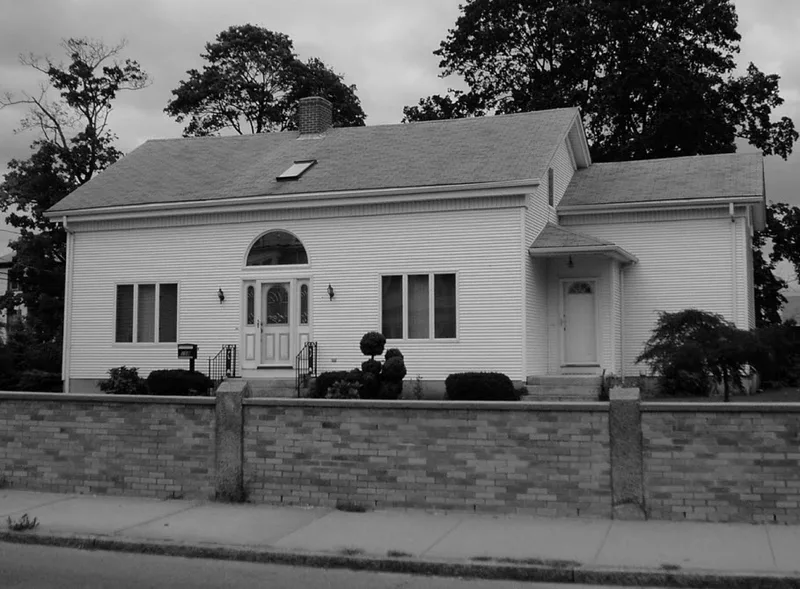
House at 108-112 Quarry Street

Why it's listed
Built around 1850 on Quarry Street in Fall River, this one-and-a-half-story clapboard cottage is a modest example of mid-19th-century vernacular Greek Revival design. It has a five-bay, side-gable plan with ells, a center chimney, four-over-four sash windows and a center door with an entablature and sidelights. Attic frieze windows are fitted with iron grates, an unusual detail that appears to be original. The same simple pilaster capitals appear on the door entablature, corner boards and side porch posts. A white picket fence with early carved granite posts encloses the small lot. The original owner is unknown; by 1871 a grocer who owned other property nearby held the house, and the date rests on stylistic evaluation. The house was listed because it is a largely intact, well-crafted cottage that contrasts with the formal, architect-designed Greek Revival mansions built for the city's elite. It remains in residential use.
Significance in brief: The form argues the house is a well-crafted, largely intact example of vernacular Greek Revival architecture in Fall River. Its five-bay side-gable plan continues an 18th-century tradition rather than the newer temple-front form. It also has unusual attic frieze windows with iron grates that appear to be original. It contrasts with the architect-designed mansions of the city elite and meets Criterion C.
Machine-generated summary. This summary was generated by a language model from the official nomination document and has not been reviewed line by line by an editor. It may contain errors. Check the source document before relying on any detail. Source: nomination document (PDF) · National Archives catalog entry. NRHP reference 83000683, listed February 16, 1983. Summary generated October 2026 (model claude-sonnet-5-5, prompt v1.0-2026-10-29, confidence medium).
Key facts
| Address | 108-112 Quarry St., Fall River |
|---|---|
| County | Bristol County |
| Listed | February 16, 1983 |
| Reference number | 83000683 |
| Resource type | Building |
| Architectural style | Greek Revival |
| Criteria |
|
| Areas of significance | Architecture |
| Level of significance | State |
| Status (as stated in the nomination) | Present use is residential; the form describes the house as in pristine condition. |
| Acreage | 0.3 |
| Coordinates | 41.70655, -71.14001 (NPS GIS) |
What listing means for this property
National Register listing is honorary for a privately owned home: it does not by itself restrict what an owner may do with their own money, and it does not require public access. Restrictions come from local landmark or historic-district ordinances, which are separate (how they differ).
Owner-occupied houses are not eligible for the 20% federal rehabilitation tax credit, which applies to income-producing buildings, but many states offer credits for homeowners. Listing also opens the door to preservation easements and to buying a plaque. Start with what listing means for homeowners, renovating a listed house and selling one.
General information, not legal or tax advice. Rules change; confirm with your State Historic Preservation Office or a qualified adviser.
Sources and further reading
- National Park Service, National Register of Historic Places database (snapshot May 2026), reference 83000683.
- Nomination form (PDF, National Archives) — catalog entry
- Wikipedia article (used for cross-checking only; text not reproduced here)
- Wikidata Q14715564
- This listing as JSON
Last updated October 2026. Found an error? See the editorial policy for how to report it.