Furnace Village Historic District

Why it's listed
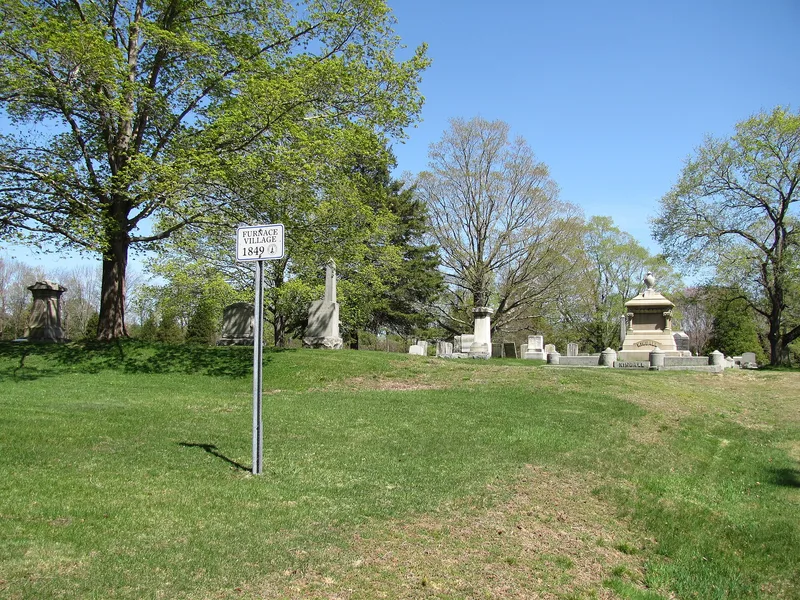
Furnace Village in Easton, Massachusetts, is a 131-acre district of mills, ponds, canals, cemeteries and modest houses shaped by water power. An iron furnace founded in 1751 by a group of nine men used local bog iron and the nearby brooks. During the Revolutionary War, owner James Perry supplied the Continental Army with cannon and cannonballs, and a retaining wall used in proofing cannon still stands by Old Pond. Sheperd Leach later expanded the water system, and by 1823 three ponds served the works. Fires destroyed most original foundry buildings, though the charcoal shed and the company office survive. Belcher Malleable Iron Company continues the industry today. The houses are mostly simple wood-frame vernacular buildings, with notable Georgian, Federal and Greek Revival examples such as the 1723 Josiah Keith House and the 1812 Lincoln-Drake House. Prehistoric artifacts and remains of early mills add archaeological value.
Significance in brief: Bog iron and water power led to an iron industry founded in 1751, one of the earliest in southeast Massachusetts, with a major foundry active during the American Revolution. The district keeps many early structures, waterways and archaeological sites, and its Federal and Greek Revival buildings reflect the area's economic cycles. Belcher Malleable Iron Company is described as the oldest continually operating malleable iron company in the United States still in its original location.
Machine-generated summary. This summary was generated by a language model from the official nomination document and has not been reviewed line by line by an editor. It may contain errors. Check the source document before relying on any detail. Source: nomination document (PDF) · National Archives catalog entry. NRHP reference 83003938, listed October 6, 1983. Summary generated October 2026 (model claude-sonnet-5-5, prompt v1.0-2026-10-29, confidence high).
Key facts
| Address | MA 106/123, Easton |
|---|---|
| County | Bristol County |
| Listed | October 6, 1983 |
| Reference number | 83003938 |
| Resource type | District |
| Period of significance | 1751-1850 |
| Architect / builder | Captain James Perry, General Sheperd Leach, principal owners |
| Architectural style | Georgian, Federal, Greek Revival and Victorian vernacular |
| Criteria |
|
| Areas of significance | Industry, Prehistoric, Historic - Aboriginal, Historic - Non-Aboriginal, Health/Medicine, Architecture |
| Level of significance | Local |
| Status (as stated in the nomination) | The iron company continues to operate today, and the district includes occupied and unoccupied properties with agricultural, commercial, park and residential uses. |
| Acreage | 131 |
| Coordinates | 42.02434, -71.13247 (NPS GIS) |
What listing means for this property
This is a historic district. Buildings within its boundary are either contributing (they add to the district's significance) or non-contributing. Owners of contributing income-producing buildings can claim the 20% federal rehabilitation tax credit; homeowners should look at state credits. National Register districts impose no design review by themselves; a local historic district ordinance, if one exists, does (the difference explained).
General information, not legal or tax advice. Rules change; confirm with your State Historic Preservation Office or a qualified adviser.
Sources and further reading
- National Park Service, National Register of Historic Places database (snapshot May 2026), reference 83003938.
- Nomination form (PDF, National Archives) — catalog entry
- Wikipedia article (used for cross-checking only; text not reproduced here)
- Wikidata Q5509627
- This listing as JSON
Last updated October 2026. Found an error? See the editorial policy for how to report it.