Rising Paper Mill

Why it's listed
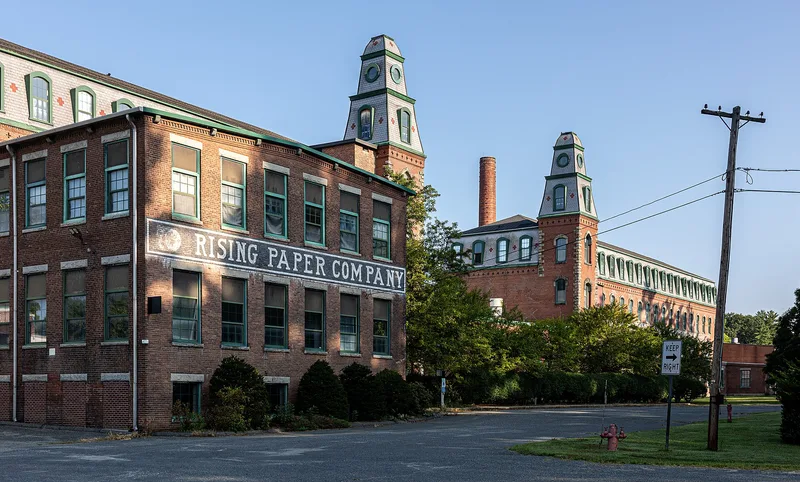
Rising Paper Mill is a brick and stone industrial complex beside the Housatonic River at Risingdale, north of Great Barrington. Built between 1873 and 1878 for H. D. Cone of the Owen Paper Company, it was intended to be the largest and best-equipped paper factory in the world. Two three-story blocks with slate mansard roofs and corner towers are joined by a lower connecting building that housed the Fourdrinier machines. Details include rusticated stone quoins and a brick frieze with Greek crosses, and the foundations use stone from nearby Monument Mountain. A historian described its ornate design as unique in the Berkshire region. Cone went bankrupt, and the mill stood unused until the B. D. Rising Company bought it around 1899 to 1900. It has operated as a paper mill since, with modernized equipment alongside an old dam, water wheels, dryers and boilers.
Significance in brief: The nomination calls it one of the finest post-1850s mills in Massachusetts. It also shows how mill architecture changed in the later nineteenth century alongside advances in paper-making technology. Its unusually ornate design is attributed to Cone, who meant it to be the largest and best-equipped paper factory in the world.
Machine-generated summary. This summary was generated by a language model from the official nomination document and has not been reviewed line by line by an editor. It may contain errors. Check the source document before relying on any detail. Source: nomination document (PDF) · National Archives catalog entry. NRHP reference 75000253, listed August 11, 1975. Summary generated October 2026 (model claude-sonnet-5-5, prompt v1.0-2026-10-29, confidence high).
Key facts
| Address | N of Great Barrington on MA 183 at Risingdale, Great Barrington |
|---|---|
| County | Berkshire County |
| Listed | August 11, 1975 |
| Reference number | 75000253 |
| Resource type | Building |
| Period of significance | 1873-1878 |
| Architect / builder | H. D. Cone of the Owen Paper Company (original owner and builder) |
| Architectural style | Second Empire; also labeled "Lombardi-Romanesque" by William H. Pierson, Jr. and "High Style Eclectic" by others |
| Areas of significance | Industry, Architecture |
| Level of significance | State |
| Status (as stated in the nomination) | Still operating as a working paper mill; the property is listed as occupied and in excellent condition, with updated equipment and some old equipment remaining. |
| Acreage | 10 |
| Coordinates | 42.24285, -73.35736 (NPS GIS) |
What listing means for this property
For an income-producing building, listing (individually or as a contributing building in a district) is the gateway to the 20% federal rehabilitation tax credit on qualified rehabilitation costs, often stackable with state credits. Work claiming the credit must follow the Secretary of the Interior's Standards and be approved in advance.
Listing does not restrict a private owner acting without federal money or permits; where federal funding or licensing is involved, Section 106 review applies.
General information, not legal or tax advice. Rules change; confirm with your State Historic Preservation Office or a qualified adviser.
Sources and further reading
- National Park Service, National Register of Historic Places database (snapshot May 2026), reference 75000253.
- Nomination form (PDF, National Archives) — catalog entry
- Wikipedia article (used for cross-checking only; text not reproduced here)
- Wikidata Q14715829
- This listing as JSON
Last updated October 2026. Found an error? See the editorial policy for how to report it.