Mill Village Historic District
Also known as: Williamstown Manufacturing Company; The Station Mill

Why it's listed
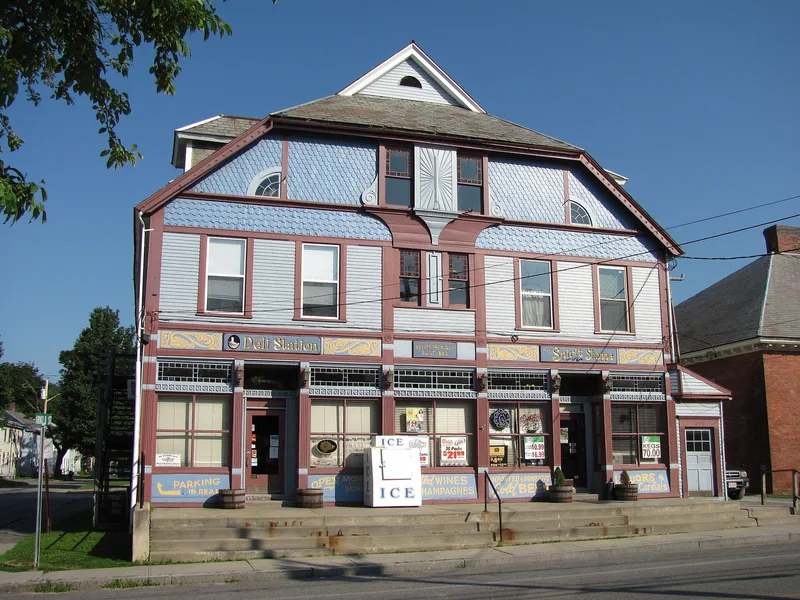
Mill Village is a planned textile community on the Hoosic River in Williamstown, Massachusetts. It was built in 1865-1867 by the Williamstown Manufacturing Company, organized by Williams College professor Paul Chadbourne with the Arnold Brothers of Adams. The district centers on a three-story brick mill and includes 24 double workers' houses in simple Greek Revival style, a superintendent's house, a machinists' house, a school and stores. French-Canadian families moved in to supply the labor, and the company owned and rented the housing. In 1878 a newspaper called the village the model manufacturing property in the state. Later, workers bought lots on the south side of Arnold Street and built their own houses, which marked a move away from company paternalism. The mill closed in 1931 and was converted to photographic paper production in 1940. The district was listed as a well-preserved example of a small planned mill community, with possible archaeological value.
Significance in brief: The nomination argues the district is locally significant as the largest and most successful textile mill in Williamstown in the late 19th century and as an excellently preserved small planned mill community. It also reflects the social and humanitarian ideals, combined with commercial interests, of its local owners and immigrant workforce. It may hold archaeological information about industrial technology, status and ethnicity.
Machine-generated summary. This summary was generated by a language model from the official nomination document and has not been reviewed line by line by an editor. It may contain errors. Check the source document before relying on any detail. Source: nomination document (PDF) · National Archives catalog entry. NRHP reference 83003926, listed October 6, 1983. Summary generated October 2026 (model claude-sonnet-5-5, prompt v1.0-2026-10-29, confidence high).
Key facts
| Address | Cole Ave., Mill, Arnold, and Elm Sts., Williamstown |
|---|---|
| County | Berkshire County |
| Listed | October 6, 1983 |
| Reference number | 83003926 |
| Resource type | District |
| Period of significance | 1865-1867 |
| Architect / builder | Paul A. Chadbourne (owner) |
| Architectural style | Greek Revival (workers' housing and store), Italianate (superintendent's house) |
| Criteria |
|
| Areas of significance | Industry, Commerce, Architecture |
| Level of significance | Local |
| Status (as stated in the nomination) | Marked occupied; uses include industrial, commercial and private residence. The mill was converted to photographic paper production in 1940 and has been altered, but the housing remains largely intact as a group. |
| Acreage | 12.9 |
| Coordinates | 42.71667, -73.18985 (NPS GIS) |
What listing means for this property
This is a historic district. Buildings within its boundary are either contributing (they add to the district's significance) or non-contributing. Owners of contributing income-producing buildings can claim the 20% federal rehabilitation tax credit; homeowners should look at state credits. National Register districts impose no design review by themselves; a local historic district ordinance, if one exists, does (the difference explained).
General information, not legal or tax advice. Rules change; confirm with your State Historic Preservation Office or a qualified adviser.
Sources and further reading
- National Park Service, National Register of Historic Places database (snapshot May 2026), reference 83003926.
- Nomination form (PDF, National Archives) — catalog entry
- Wikipedia article (used for cross-checking only; text not reproduced here)
- Wikidata Q6858442
- This listing as JSON
Last updated October 2026. Found an error? See the editorial policy for how to report it.