Blackinton Historic District

Why it's listed
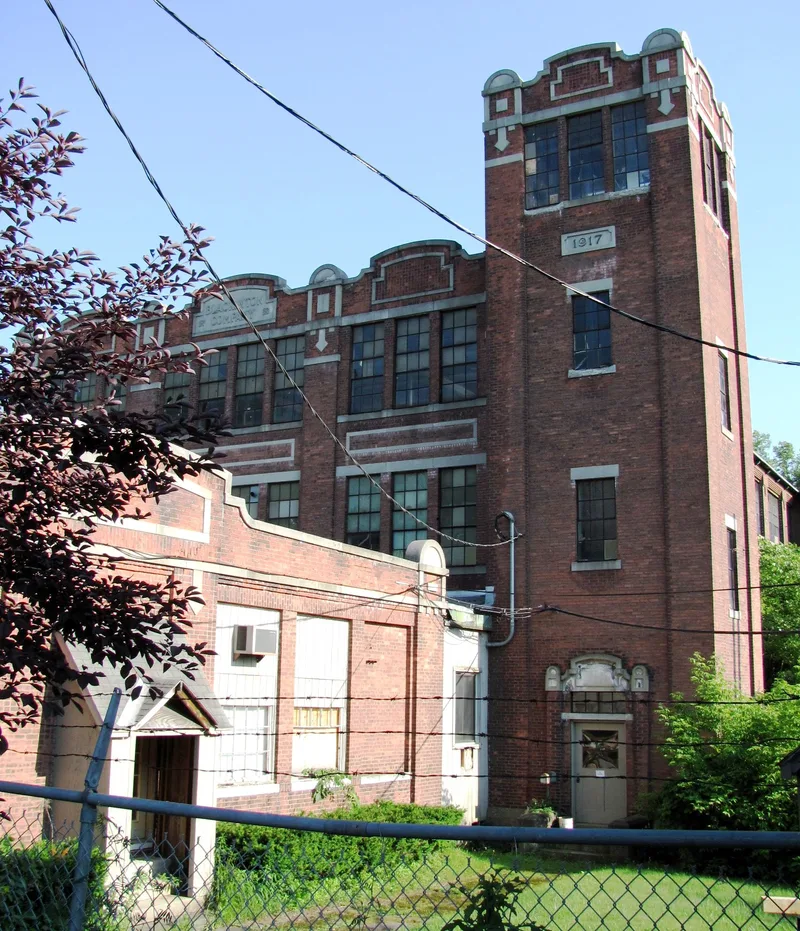
Blackinton is a small mill village strung along Massachusetts Avenue at the western edge of North Adams, beside the Hoosac River and the railroad tracks. Sanford Blackinton and partners built a woolen mill here in 1822, and the community grew around it with worker housing, a company store, two churches and mansions for mill owners. The surviving mill dates mainly from 1872, 1908 and 1917 and includes a Tudor Revival crenelated tower. Nearby are four Greek Revival workers' houses from about 1840, the 1839 company store, and the Federal and Italianate Wells-Archer House from about 1832. Other landmarks include the Gothic Revival Union Church of 1871 and the Downing-inspired Monroe Temple House of 1858. The district was listed because it is the most intact nineteenth-century mill community in the city, preserving a cohesive group of industrial, residential and church buildings linked to a leading local industrialist.
Significance in brief: It is described as the best-preserved and most intact 19th-century mill community in North Adams, with well-preserved residential, industrial and ecclesiastical architecture. It is tied to Sanford Blackinton, a leading North Adams industrialist, who founded the mill community. The district retains integrity of setting, design, materials and association.
Machine-generated summary. This summary was generated by a language model from the official nomination document and has not been reviewed line by line by an editor. It may contain errors. Check the source document before relying on any detail. Source: nomination document (PDF) · National Archives catalog entry. NRHP reference 85003384, listed October 25, 1985. Summary generated October 2026 (model claude-sonnet-5-5, prompt v1.0-2026-10-29, confidence high).
Key facts
| Address | Roughly Massachusetts Ave. between Ashton and Doanes Aves. and Church Hill and Boston & Maine RR, North Adams |
|---|---|
| County | Berkshire County |
| Listed | October 25, 1985 |
| Reference number | 85003384 |
| Resource type | District |
| Period of significance | 1830-1917 |
| Architect / builder | Marcus Fayette Cummings (attributed, Union Church); Blackinton Company (builder of Union Church); Monroe Temple and William A. Hopkins (builders of their own houses) |
| Architectural style | Federal, Greek Revival, Italianate, Gothic Revival, Stick Style, Queen Anne, Tudor Revival |
| Criteria |
|
| Areas of significance | Industry, Architecture |
| Level of significance | Local |
| Status (as stated in the nomination) | The former company store is presently used as a warehouse; the four workers' houses near the mill are in a fine state of preservation. Many houses outside the district core have been altered. |
| Acreage | 240 |
| Coordinates | 42.70422, -73.16449 (NPS GIS) |
What listing means for this property
This is a historic district. Buildings within its boundary are either contributing (they add to the district's significance) or non-contributing. Owners of contributing income-producing buildings can claim the 20% federal rehabilitation tax credit; homeowners should look at state credits. National Register districts impose no design review by themselves; a local historic district ordinance, if one exists, does (the difference explained).
General information, not legal or tax advice. Rules change; confirm with your State Historic Preservation Office or a qualified adviser.
Sources and further reading
- National Park Service, National Register of Historic Places database (snapshot May 2026), reference 85003384.
- Nomination form (PDF, National Archives) — catalog entry
- Wikipedia article (used for cross-checking only; text not reproduced here)
- Wikidata Q4923036
- This listing as JSON
Last updated October 2026. Found an error? See the editorial policy for how to report it.