Clinton African Methodist Episcopal Zion Church (Additional Documentation)

Why it's listed
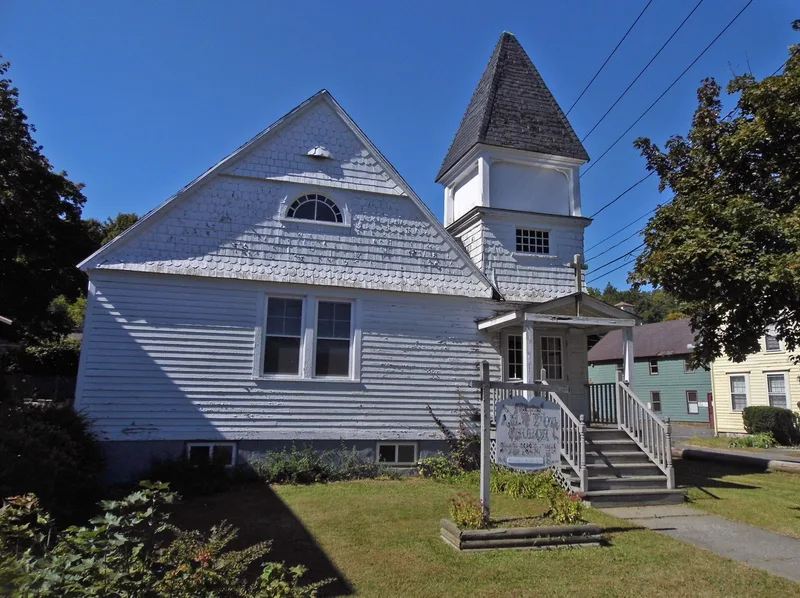
Built in 1886 on Elm Court, one block west of Main Street in Great Barrington, this small wood-frame church was erected for the town's African Methodist Episcopal Zion congregation at a cost of about $2,000. It has a front-gabled roof, clapboard siding, bands of decorative shingles, and a three-stage corner bell tower with a pyramidal roof. A 1½-story parsonage was attached to the rear in 1939. Inside is one large room with a vaulted ceiling and exposed decorative trusses, with a stone-walled basement below. Over time the surroundings changed from a mixed residential neighborhood to the back of a dense commercial district. The church is recognized for its role in the religious and social life of African Americans in Berkshire County, including its congregation's struggles with finances and membership, and for its connection to W.E.B. Du Bois. It is also valued as a representative example of late Victorian vernacular church design in the region, with a period of significance from 1886 to 1958.
Significance in brief: The church is significant for its link to the religious and cultural heritage of African Americans in Berkshire County and as a distinctive example of late-19th-century vernacular church architecture. It is also tied to W.E.B. Du Bois and his family's community. It is significant at the local level under Criteria A and C.
Machine-generated summary. This summary was generated by a language model from the official nomination document and has not been reviewed line by line by an editor. It may contain errors. Check the source document before relying on any detail. Source: nomination document (PDF) · National Archives catalog entry. NRHP reference 08000464, listed May 29, 2008. Summary generated October 2026 (model claude-sonnet-5-5, prompt v1.0-2026-10-29, confidence medium).
Key facts
| Address | 9 Elm Ct., Great Barrington |
|---|---|
| County | Berkshire County |
| Listed | May 29, 2008 |
| Reference number | 08000464 |
| Resource type | Building |
| Period of significance | 1886-1958 |
| Architectural style | Late Victorian: Shingle Style |
| Criteria |
|
| Areas of significance | Architecture, Black, Religion, Ethnic Heritage-Black, Social History |
| Level of significance | Local |
| Status (as stated in the nomination) | Still used as a religious facility; the church has replacement windows, a covered porch and asphalt roofing, and the original rear vestry was absorbed into the 1939 parsonage addition. |
| Acreage | 0.9 |
| Coordinates | 42.19654, -73.36277 (NPS GIS) |
What listing means for this property
Religious properties are listed for their architectural or historical significance, not their religious use. Listing is honorary and does not restrict the congregation's use of the building. The federal rehabilitation credit is generally unavailable unless part of the building is income-producing; some state programmes and preservation grants do cover religious buildings. Federal funding or permits trigger Section 106 review.
General information, not legal or tax advice. Rules change; confirm with your State Historic Preservation Office or a qualified adviser.
Sources and further reading
- National Park Service, National Register of Historic Places database (snapshot May 2026), reference 08000464.
- Nomination form (PDF, National Archives) — catalog entry
- Wikipedia article (used for cross-checking only; text not reproduced here)
- Wikidata Q16827114
- This listing as JSON
Last updated October 2026. Found an error? See the editorial policy for how to report it.