Union Hall
Also known as: Truro Town Hall

Why it's listed
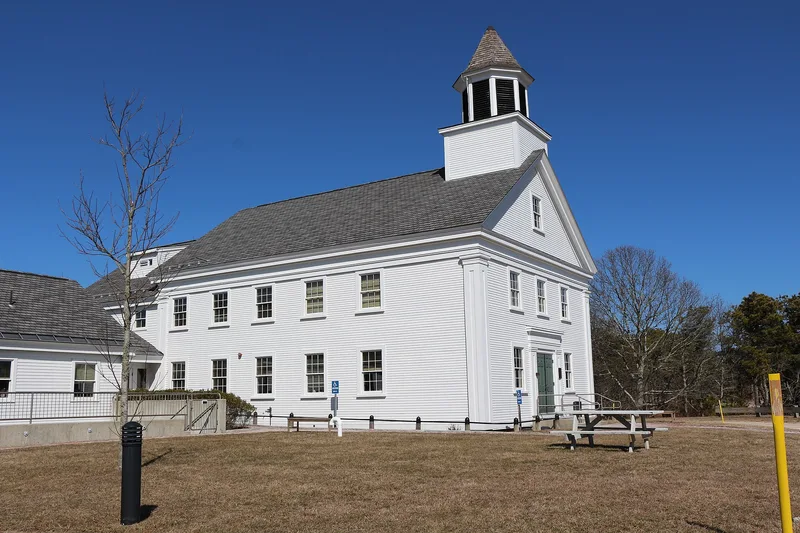
Union Hall, later known as Truro Town Hall, sits atop Great Hill in Truro near the end of Cape Cod, visible from both the Atlantic side and Cape Cod Bay. Built in 1848, it is a symmetrical Greek Revival building in the meetinghouse style, with a gable-front facade, corner pilasters, a full pediment and an octagonal tower straddling the ridge. Inside, a second-floor meeting room keeps its barrel-vaulted ceiling carried by timber scissor trusses. Five local men bought the land in 1848 and sold shares in the Union Hall Association to create a home for fraternal societies. The Town rented space from 1850 and bought the building between 1867 and 1879. Over time it held town offices, shoe, hat and shirt manufacturing, a library, dances, plays and lectures. The property was listed for its architecture and for its role in the town's civic and social life, with a period of significance from 1848 to 1946.
Significance in brief: The building is a well-preserved example of mid-19th-century Greek Revival civic architecture and relates visually to the 1827 Congregational Church nearby. It reflects the social, economic and civic life of Truro, from its origin as a fraternal meeting hall to its long use for town government and community events.
Machine-generated summary. This summary was generated by a language model from the official nomination document and has not been reviewed line by line by an editor. It may contain errors. Check the source document before relying on any detail. Source: nomination document (PDF) · National Archives catalog entry. NRHP reference 97000470, listed May 23, 1997. Summary generated October 2026 (model claude-sonnet-5-5, prompt v1.0-2026-10-29, confidence medium).
Key facts
| Address | 24 Town Hall Rd., Truro |
|---|---|
| County | Barnstable County |
| Listed | May 23, 1997 |
| Reference number | 97000470 |
| Resource type | Building |
| Period of significance | 1848-1946 |
| Architectural style | Mid 19th Century: Greek Revival |
| Criteria |
|
| Areas of significance | Architecture, Community Planning and Development |
| Level of significance | Local |
| Status (as stated in the nomination) | Continues to serve as a community resource and local meeting location; current functions include meeting hall, city hall and auditorium. |
| Acreage | 5.1 |
| Coordinates | 41.99830, -70.05353 (NPS GIS) |
What listing means for this property
National Register listing is honorary for a privately owned home: it does not by itself restrict what an owner may do with their own money, and it does not require public access. Restrictions come from local landmark or historic-district ordinances, which are separate (how they differ).
Owner-occupied houses are not eligible for the 20% federal rehabilitation tax credit, which applies to income-producing buildings, but many states offer credits for homeowners. Listing also opens the door to preservation easements and to buying a plaque. Start with what listing means for homeowners, renovating a listed house and selling one.
General information, not legal or tax advice. Rules change; confirm with your State Historic Preservation Office or a qualified adviser.
Sources and further reading
- National Park Service, National Register of Historic Places database (snapshot May 2026), reference 97000470.
- Nomination form (PDF, National Archives) — catalog entry
- Wikipedia article (used for cross-checking only; text not reproduced here)
- Wikidata Q7885732
- This listing as JSON
Last updated October 2026. Found an error? See the editorial policy for how to report it.